I'm a Vibe Coder, I have built a Social Network, an $81M Startup Clone, and an Entire Operating System. Here's What I Learned.
Designers are the most dangerous builders on the internet. I built a social network, an OS, and cloned an $81M startup to prove it.

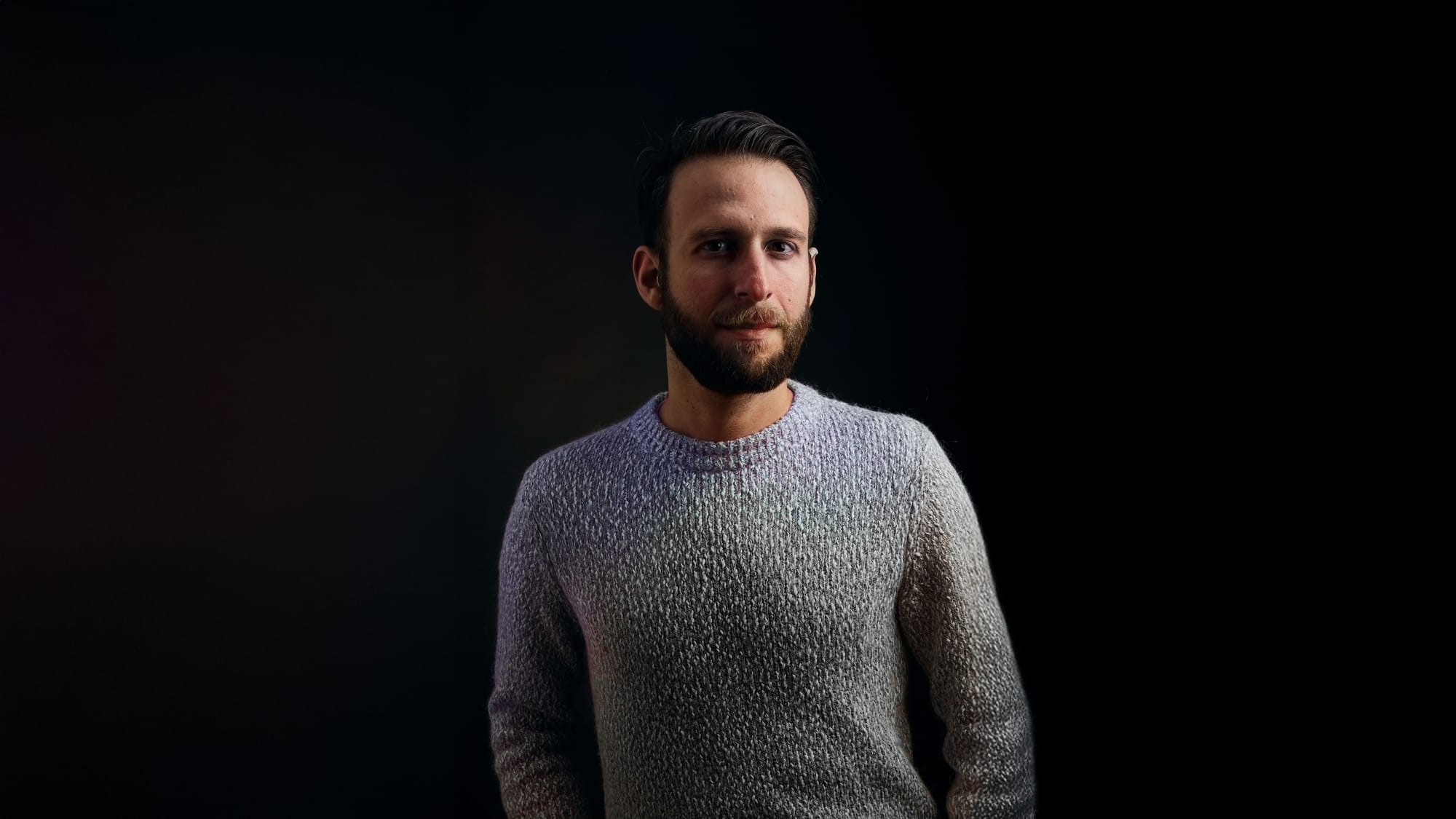
An interview with Adam Perlis conducted by Claude.
Let me say the quiet part loud: designers are the most dangerous builders on the internet. Not developers. Designers.
I know that sounds like a hot take. So let me back it up with what I've actually built over the past year and a half using nothing but AI, a Claude Max subscription, and the design instincts I've spent my career developing.
I built B150, a fully functional social network tailored for the AI community that replicates everything LinkedIn does. I built Walkie, a voice-to-text desktop tool that matches or beats Wispr Flow, a startup that has raised $81 million. And I built Transistor OS, an AI-first operating system that I believe could one day rival macOS or Windows.
I did all of this as a product designer. And I want to tell you why you can too.
I saw this coming. In early 2025, I made a prediction on LinkedIn that this shift was inevitable. Then at the start of 2026, I doubled down with a public call on X that vibe coders would become one of the defining forces of the year. Both times, I wasn't wrong.
Sorry for the funny face...(terrible UX at X doesn't let you edit the thumbnail!)
My top 3 UX and Design predictions for 2026...
— Adam Perlis (@AdamPerlis) January 5, 2026
Design is not dying. It is evolving, and designers are more relevant than ever. pic.twitter.com/qKAW9n38cm
It Started With Frustration, Not Vision
The origin story isn't glamorous. I wasn't trying to become a builder. I was trying to ship a product.
I had an idea for an AI recruiting assistant. This was right at the start of the AI wave, and I genuinely believed recruiting was ready to be disrupted. I brought in a friend, a very senior developer, to build it with me. The problem was he had a full-time job. Development moved slowly. Momentum kept stalling.
That's when I started hearing about AI-assisted coding. I was skeptical. I wasn't a developer. Sure, I knew HTML, CSS, JavaScript, and React. I'd once fumbled through a Ruby on Rails tutorial with a tutor holding my hand. But I couldn't have built anything with a real backend on my own. Not even close.
I downloaded Cursor anyway. I typed in what I wanted to build. And the results blew me away.
Not everything worked. But roughly 80% of the time, it just... nailed it. I showed what I'd built to my friend, the senior Amazon engineer, and he was visibly shocked at how far I'd gotten. That was the moment I knew this was going to change everything.
Why Designers Have the Unfair Advantage
The AI recruiting assistant eventually got shelved. The real barrier wasn't the tech. It was data. To make the tool genuinely useful, I'd need LinkedIn-level data access. That costs around $100,000 a year. Not exactly a bootstrapper's dream.
So I made a pivot that turned out to be the most important decision I've made as a founder: instead of buying the data, I'd build the network that owns the data.
That became B150, a social network built specifically for the AI community. And I built the entire thing myself, in under three months, for under $300 in Cursor credits, using Claude Sonnet 3.5.
"I want to share something inspiring... I built a social network myself." Read the full story on LinkedIn
When I tell people that, they usually ask: how?
The answer is simpler than they expect. I already had the hardest part. I had taste. I had years of building world-class user experiences professionally. I understood humans: what they want, what frustrates them, what makes them stay and what makes them leave.
Here's the thing about AI that most people miss: AI is exceptional at writing code. It is not great at understanding humans. That gap is exactly where designers live. When everyone else is focused on what AI can do, designers should be focused on what it can't, and leveraging that gap ruthlessly.
A developer vibe-coding B150 might have produced something technically competent. But the reason B150 works isn't the code. It's the strategic insight behind it: that designers, AI practitioners, and the emerging talent in this space were being forced to live on platforms that were never built for them. LinkedIn, X, Reddit. These are crowded, noisy, impersonal. I saw that gap because I am a designer. I felt it personally. And because I'm a designer, I could build something that actually addressed it.
Strategy plus taste plus technical execution plus AI. That's the combination. And designers already have three of the four.
"If I Can Clone Wispr Flow, Can I Clone Anything?"
After B150, I found myself using Wispr Flow constantly. It's a voice-to-text transcription tool that lets you dictate into any text input on your computer using a hotkey. Incredibly useful. But I kept hitting the paywall.
I started looking for alternatives and found an open-source tool called Handy, essentially a free clone of Wispr Flow. It was solid, but slower, and missing features I wanted. And then a thought hit me: Cursor and Antigravity are literally forks of VS Code. This is just how software works now.
So I forked Handy and started building on top of it.
Three days later, I had a working prototype. Within two to three weeks, while not even working on this full-time, I had a complete, polished product that was, in my honest assessment, as good as or better than Wispr Flow. That's the product I call Walkie.
Watch the demo and see for yourself: Walkie in action on X
I cloned Wispr Flow and I'm giving it away for free pic.twitter.com/f0DSu17iQ0
— B150ai (@b150ai) March 26, 2026
But the more interesting thing that happened was the question it planted in my head: if I can clone Wispr Flow, can I clone anything? What would be the hardest thing to clone?
An operating system.
Building an OS From Scratch
I know how that sounds. But stay with me.
The reasoning was actually quite strategic. If AI makes it trivially easy to clone software, and it increasingly does, then the only entity that wins long-term is whoever owns the operating system layer. Because every piece of software has to live somewhere. The OS is the last high ground.
So I decided to build one. Not a traditional OS, but an AI-first one: built for the web, designed around agentic workflows, with a user experience that would make the current generation of tools look like MS-DOS.
I called it Transistor OS.
I announced it publicly and the response was immediate. See the post on X
It feels like every week I am pushing myself to go further and further with AI. Sometimes I am just blown away what is possible...until now.
— Adam Perlis (@AdamPerlis) April 2, 2026
Never in my wildest dreams did I think, oh hey, you know what would be a great idea to build on a Monday evening till 2am...? pic.twitter.com/vzBmJiMKR5
There was another thing fueling this idea too. I'd been watching more and more of my friends use AI to build completely custom tools for themselves, whether for their personal lives or their work. And as an entrepreneur, that's always been something I wanted. I used to stitch together Airtable tables and connect them via APIs, leaning on Zapier to make everything talk to each other. We figured it out eventually, but it took forever, cost a lot of money, and required tools that honestly weren't that good. The whole experience was a grind. And I kept asking myself: do I build what I need, or do I buy something off the shelf and compromise? How much is it going to cost me to keep buying software forever, versus just building exactly what I want? That was a genuine light bulb moment. Because if we can give other people a platform to build tools that are uniquely theirs, and that platform is beautifully designed and actually well thought out from a UX perspective, that's how you win.
The timing was right in another way too. Walkie had given me a workflow I was obsessed with: using voice transcription to talk to Claude Code and direct my vibe coding sessions. It felt like the beginning of something. Tools like Open Interpreter were getting attention, but the UX was abysmal: either a terminal interface or a barely-designed GUI. I kept thinking there has to be a better way to interact with an agentic AI. A properly designed, web-based environment where an AI can act as your actual personal assistant, managing your calendar, your workflows, your projects, your life.
That's Transistor OS. It's currently in beta, being tested carefully. Security is a top priority. It's one of the biggest fears around AI agents, and we want to get it right. But the vision is real: an AI-first operating system that makes the agentic future actually accessible to normal humans, not just developers who don't mind living in a terminal.
The Actual Workflow (The Part You've Been Waiting For)
Every project starts in Claude. Not in a code editor. In a conversation. I'll open a project folder and spend time thinking out loud with Claude, working through what I'm trying to build, why it matters, what the user experience should feel like. At the end of that session, I generate a summary. That becomes my brief.
Then I open my IDE. I've been using Google Antigravity lately, though Cursor works too. The key move: I load the Claude Code plugin and use my Claude Max subscription to power it. This alone has saved me hundreds of dollars compared to running tokens through Cursor or Antigravity directly. Claude Max is the best model at the best per-token cost, and routing through the plugin is just smarter economics.
From there, I initialize a GitHub repo. This is non-negotiable and should be your first step on any project. Then I put Claude Code into plan mode and ask it to help me architect what I'm building. We'll work through the technical stack together.
For most of my web projects, that stack looks like this: Next.js or Vite for the framework, Radix as a primitive component library, ShadCN on top of Radix for pre-built components, and Tailwind for styling. These four tools are extremely well-aligned. They were basically designed to work together, and Claude knows them extremely well, which means fewer errors and faster iteration.
For deployment, I almost always use Vercel. Their interface is clean, their products are excellent, and they built Next.js, so the integration is seamless. For databases I'll use Supabase or Neon depending on the project. For cross-platform development, Expo via React Native is outstanding. And for native macOS applications, Tauri, built on Rust, is doing incredible things.
I didn't know most of these tools existed eighteen months ago. I learned all of them by asking Claude.
What I'd Tell the Designer Sitting On an Idea Right Now
What the heck is stopping you?
Get a Claude Max subscription. Open Claude Code. Explain your idea. Start building.
I mean that without condescension. I know the voice in your head that says but I'm not a developer. I had that voice too. What I've learned is that voice is a lie, or at least, it's become irrelevant.
You already have what AI can't give you. You understand users. You have taste. You know what good looks like. You can see the gap between what exists and what should exist. Those are the inputs that determine whether a product is worth building. The code is almost beside the point now.
Developers have had a monopoly on building for a long time. That monopoly is over. The only question is whether designers will recognize their moment and take it.
If you're stuck, start small. Pick one idea. Spend an afternoon talking it through with Claude. See how far you get. You might be shocked.
And consider this: I have friends who have never been a designer and never been a developer. One ran a nanny business. Another was a Spanish teacher. Another was a golf coach. All of them are vibe coding tools today that are helping them propel their businesses forward. If they can do it, you have absolutely no excuse.
And if you don't know something, just ask Claude.
Adam Perlis is the founder of Academy UX and B150, and the builder behind Walkie and Transistor OS.
Follow him on X: @AdamPerlis | Follow B150: @b150ai