Podcast: Learn Duolingo's Secret to Hiring Top Talent — Mig Reyes, Head of Product Design, Duolingo
In this episode, Mig Reyes, Head of Product Design at Duolingo, discusses innovative hiring and retention strategies with host Adam Perlis, CEO at Academy.

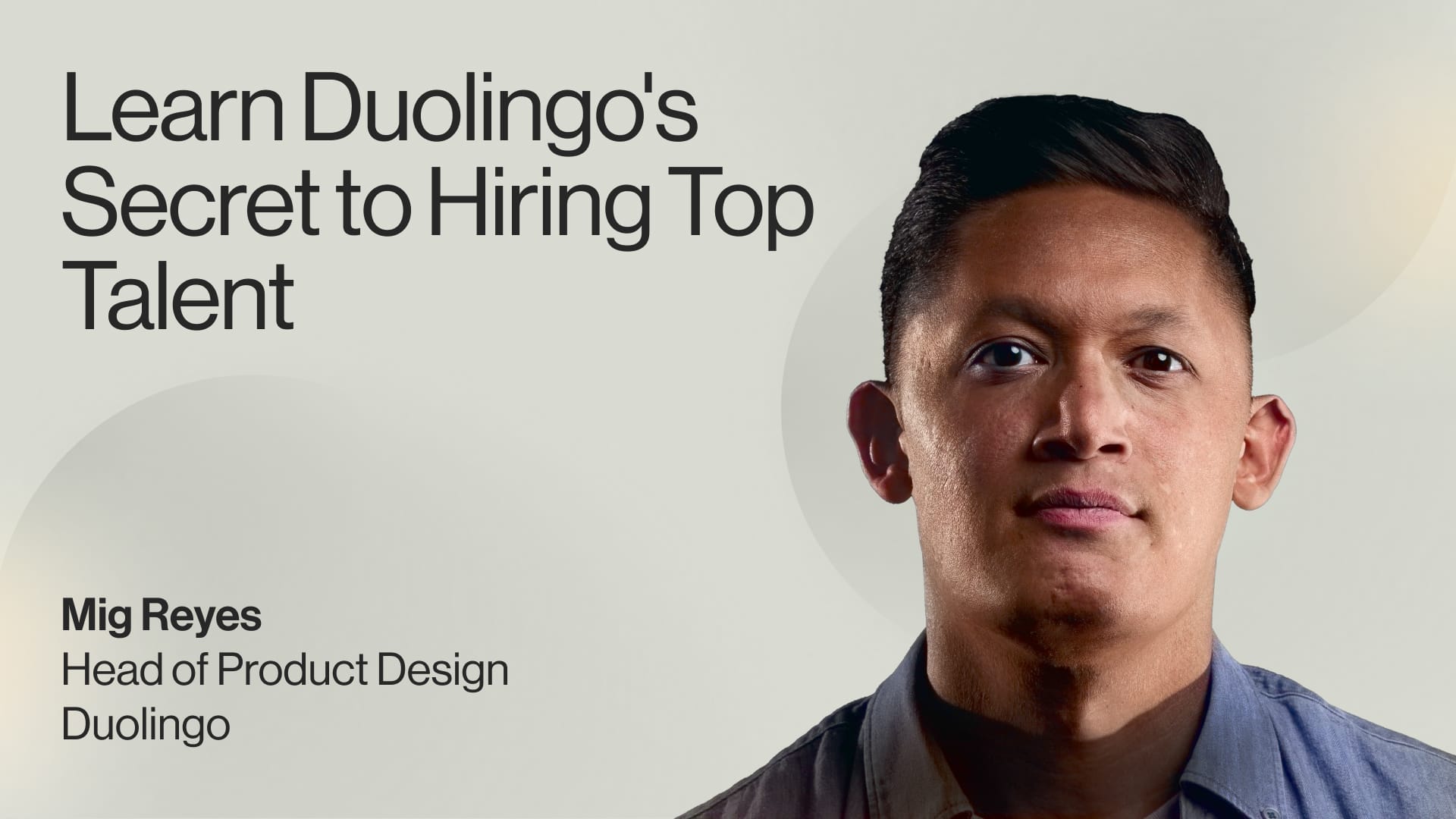
In this episode, we sit down with Mig Reyes, Head of Product Design @ Duolingo. We explore Duolingo's innovative approach to hiring and retaining talent.
Host: Adam Perlis, CEO at Academy
🔴 Listen on YouTube:
🎧 Listen on Spotify:
Mig Reyes is Head of Product Design at Duolingo, where he oversees design for the company's entire learning product. Before Duolingo he spent years at Instagram as director and head of design for Product Foundation (design systems across iOS, Android, and web), and earlier led design at Trunk Club (acquired by Nordstrom), Sprout Social, 37signals, and Threadless. He's a former president of AIGA Chicago and started the city's CreativeMornings chapter.
Key Takeaways
- Duolingo runs a two-tier internship program — 'Thrive' for sophomores from underrepresented backgrounds, then a standard graduate internship — that builds a long hiring pipeline the company can already forecast into next year's headcount.
- The internship program is the main way Duolingo tackles the industry's diversity problem, by investing in early-career talent while they're still in school rather than competing for the same proven senior hires everyone else is chasing.
- Duolingo avoided the 2023 layoff wave by deciding in late 2022 to cancel the aggressive hiring plan they had built for 2023, rather than hiring fast and then cutting. No layoffs, no hiring freeze — just 'never mind' on the new headcount.
- 'Never settle on talent' is a Duolingo operating principle. Mig's bar is two-part: competence AND calibration to the company's values. 'I'd rather take months to find the right person.'
- Recruiting is still a product problem at Duolingo. The quality of the app itself — the animations, the details, the craft — is one of the company's strongest recruiting signals. 'You have to make something awesome for people to want to make it even more awesome.'
- Early-career designers at Duolingo get paired with mid-level designers (not just seniors) through a host-and-buddy system, which gives mid-level designers early practice at mentorship and management — creating a leadership pipeline before there are formal openings.
- Duolingo's retention is partly a compounding effect of slow, intentional hiring: because the company didn't hire aggressively, everyone already there had room to grow, and long-tenured employees graduated into VP, director, and C-suite roles.
- At 740 employees and 13 years old, Duolingo still obsesses about craft at the level of 'exclamation mark vs. period in the UI copy' — Mig credits this with keeping senior people close to the actual work instead of mired in 'the work around the work.'
Frequently Asked Questions
› How does Duolingo hire junior designers?
Through a two-tier internship program. Tier one is called Thrive: an 8-10 week summer program specifically for underrepresented sophomores who are still exploring whether tech, design, and product are for them. Tier two is a standard 10-week graduate internship with more realistic projects, real performance reviews, and potential return offers. Mig says Duolingo's hiring forecast already accounts for expected return-offer conversions, so the company effectively knows who its most junior hires will be a year in advance.
› Why does Duolingo invest so heavily in early-career talent instead of senior hires?
Two reasons. First, diversity — Mig is direct that the industry has a diversity problem and investing early in underrepresented talent is the most effective way Duolingo has found to build a more inclusive team. Second, geography and mission — Duolingo is based in Pittsburgh and led by Luis von Ahn, a Carnegie Mellon educator, and the company prefers to grow talent from the ground up rather than compete with Bay Area tech for the same proven senior candidates.
› How did Duolingo avoid the 2023 tech layoffs?
At the end of 2022, Duolingo's executive team had an aggressive 2023 hiring plan ready to go. Instead of executing it, Luis and the exec team stood up in front of the company and said 'never mind' — they wouldn't open most of the planned roles and, crucially, wouldn't do any layoffs either. Recruiters and coordinators who would have been underwater got to take on internal projects and process improvements. Mig contrasts this directly with his experience at Instagram during the COVID-era rapid hiring and subsequent spreadsheet-of-names layoffs.
› What does Duolingo look for when hiring senior designers?
Competence AND calibration. Mig's own boss told him when hiring him: 'I was worried you were going to be competent but not calibrated.' Competence is table stakes; calibration means fit with how Duolingo operates and what it values. 'Never settle on talent' is an explicit operating principle at the company, and Mig says they'd rather take months to find the right person than fill a seat.
› How does Duolingo stand out to world-class design talent?
First, by being brutally honest about how hard the work is. Mig believes the best talent isn't looking for an easy walk in the park — they want to be motivated by hard problems, so Duolingo states the challenge explicitly. Second, by letting the product do the talking. 'If you've used Duolingo, you very quickly realize holy cow, some team really built this thing — the animations, the attention to detail. You can feel the sense of love and care in our app. That is a recruiting tool.' Recruiting, Mig says, is still a product problem.
› How does Duolingo achieve low attrition?
Mig says it's largely a knock-on effect of the intentional-hiring strategy. Because Duolingo didn't hire aggressively during the boom, everyone already there had room to grow into bigger roles. Long-tenured employees have moved up into VP, director, and C-suite positions, which created a culture where new hires can see a clear path for themselves. On top of that, Duolingo's continued obsession with craft — debating an exclamation mark versus a period in UI copy — keeps even senior people close to the actual work instead of getting lost in org politics.
› What was Mig Reyes's career path before Duolingo?
Mig spent most of his career in Chicago. He started at the community-driven t-shirt company Threadless, moved to 37signals (where Jason Fried handed him a blank terminal on day one and told him to learn git), led design at the fashion startup Trunk Club (acquired by Nordstrom), became director of product design at Sprout Social, and then moved to New York as director and head of design for Product Foundation at Instagram — overseeing the design system across iOS, Android, instagram.com, and notifications. Ryan Sims, Duolingo's Chief Design Officer, recruited him at the end of 2022.
› How do interns and early-career designers get paired with mentors at Duolingo?
Through a host-and-buddy system. Crucially, mentors aren't always senior designers. Recent mid-level hires who've just been promoted out of their own early-career phase are deliberately matched with interns, which gives those mid-level designers early practice at mentorship and management skills. Senior designers and full-time managers are the safety net. The goal is to create leadership development opportunities for everyone, not just the most senior people.
› How can someone apply for a design role at Duolingo?
Mig says the fastest path is the company's LinkedIn page, careers page, and campus visits. But he also explicitly encourages early-career students to reach out directly to Duolingo employees on LinkedIn with a thoughtful message — 'we really value effort,' he says, and cold outreach that shows initiative stands out from the inundated applicant pool.
› Where can I find Mig Reyes online?
LinkedIn (search his name) and Threads (@migra). He's not on X/Twitter. He's also open to email and says connecting with aspiring designers and design leaders is one of his favorite parts of the job — consistent with his history leading AIGA Chicago and founding the city's CreativeMornings chapter.
Full Transcript
› Read the full conversation transcript
Adam: Hey everybody, welcome to How We Scaled It for Design Teams. Today we have the pleasure of speaking with Mig Reyes, Head of Product Design at Duolingo, about Duolingo's innovative approach to hiring and retaining talent.
Mig: I've been in design and product for roughly two decades. I started as a graphic designer, went to art school, tried my hand at agency life, and realized I didn't like clients, so I went in-house and never looked back. Most of my career has been in Chicago, so I've got a Midwest chip on my shoulder — working for small teams and small companies with really big aspirations. One of my first jobs was a t-shirt company called Threadless. Then I went down the alley in the same Chicago neighborhood to 37signals, where my boss Jason Fried is known for being an against-the-grain personality. My first day there they opened a blank terminal and said 'congratulations, you're going to learn git' — that's where I switched formally from brand and graphic design to product design.
From there I moved into design management — head of design for a fashion startup called Trunk Club, which was acquired by Nordstrom — then director of product design at Sprout Social. From Sprout I moved to New York to take on a director and head of design role at Instagram, in an organization called Product Foundation. I oversaw the entire design system on Android, iOS, instagram.com, our notifications, and performance platform systems. I wasn't looking for a new gig — I loved my time at Instagram — but Duolingo came knocking. Our CDO Ryan Sims emailed me at the end of 2022 and said 'hey, we could use some of your experience on the product design team.' Eleven months in, I now lead the entire product design team at Duolingo.
Adam: You guys have this amazing program for hiring junior talent, which is unusual. How does Duolingo approach this?
Mig: It was probably my biggest learning curve switching from Instagram to Duolingo. At Instagram you typically have a very senior team handling a lot of scope with few people. At Duolingo we have the same high expectations but we're very specifically looking to invest in early-career talent — starting while they're still in school. We run a two-tier internship program. The first tier is Thrive: an 8-10 week summer program, and we very specifically invest in underrepresented early-career folks who are still in school. I'm not saying anything too spicy here — we have a diversity challenge in the industry, and this is how we build a more diverse team and invest in the future of our industry.
From Thrive you graduate to our more standard graduate internship — another 10 weeks, with more realistic projects, performance evaluations like any employee, and potential return offers. Our hiring forecast already accounts for successes from the internship program. We know by next year who we're hiring as our most junior talent.
Adam: Where did this commitment come from?
Mig: Luis himself, our CEO, is an educator at Carnegie Mellon, and a lot of our executive leadership team are educators or former teachers. We're based in Pittsburgh. The industry says find senior people and compete for the same senior talent — we'd rather lean into our mission of educating others and invest from the ground up. It's about a commitment to the future, to our learners, and to our Duos — our employees.
Adam: Do juniors pair up with senior talent?
Mig: This creates a long runway for leadership development. It doesn't have to be senior talent taking on interns. Mid-level designers — recent graduates who've since been promoted — can look backward and say 'hey, I was in your shoes, I'm here to help.' We have a host-and-buddy system. Mid-level designers practice management and mentorship skills, and we have senior designers and full-time managers to catch everyone if they trip. We want to give everyone, even early-career folks, a sample of what it's like to help develop others. On projects: we try to make it as realistic as possible and we really don't want to hold your hand too much. We'd rather rip the Band-Aid off on critical feedback early so they're more prepared for the real workforce later.
Adam: How do you stand out as talent applying to a place like Duolingo?
Mig: Duolingo is still a small company — around 740 employees — yet we've been around 13 years and we're publicly traded. To get there you keep a really high concentration of incredible co-workers. 'Never settle on talent' is one of our operating principles. The obvious thing is state your intentions — everybody wants to hire the best, but not everyone is saying specifically what that looks like. We're very plain: here's how hard the challenges ahead are. The most talented people don't want an easy walk in the park; they want hard problems. It's not free lunch and foosball tables, although we have both — it's more about the caliber of your co-workers.
The other thing is the work speaks for itself. If you've used Duolingo you very quickly realize 'holy cow, some team really built this thing.' The animations are like nothing other apps do. You can feel the love and care in the app. That is a recruiting tool. You invest in the quality of the product and that sends a signal to the people who'd want to work at Duolingo that this team really cares about quality. Recruiting is still a product problem — you have to make something awesome for people to want to make it even more awesome.
Adam: You guys came out of the 2023 tech layoffs relatively unscathed. What's the secret?
Mig: First, I want to say this is real hard. I was at Instagram during the COVID hiring boom and I was there for the spreadsheets with real names on them, where I had to tell people the next day that they no longer had a job. If you've been affected, I'm with you. Back in 2022, Duolingo was prepping higher headcount levels too. Wall Street was starting to say 'hey tech world, you should probably be profitable.' I think largely the intuition of our executive team sensed that rapid crazy hiring wasn't what we should be doing anyway. At the end of 2022 heading into 2023, Luis and the exec team stood up and said: never mind, we're not going to go bonanzas on headcount and hiring. It was a strategic decision. We didn't do a hiring freeze — we just said we won't open all the roles we anticipated, and we won't do any layoffs.
We committed to the people who were here. Recruiters and coordinators got to take on new internal opportunities or process improvements they never had time to make. It was foresight, healthy planning, and hard decision-making rigor: we know tech is doing this; we're going to do that. The second thing: we just continued to invest in our Duos. If we're hiring, that's a privilege — we have to get it right. We'd rather take months to find somebody, as long as it's the right somebody. My boss told me when he hired me, 'I was worried you were going to be competent but not calibrated.' Bringing somebody from outside with their own points of view on how to run a team is a very real thing. We try to make sure talent is values-aligned and exceptionally high, and only until those two criteria are satisfied would we offer a role.
Adam: Duolingo also has really low attrition. How do you do that?
Mig: One of the things that made me want to join was that when I interviewed, everyone had been there eight, ten, twelve years — something good is happening here. It's actually correlated to the hiring question: because we didn't hire aggressively, everyone who's here has had room to grow. Now there are people in the C-suite, VPs, directors, who've grown with Duolingo. We invest in who's here now. We have a healthy pipeline from early-career to seasoned executive and everyone in between, and that makes for a more stable workplace.
The conversations we're starting to have now are about leadership development: building benches, senior teams, succession planning — things a lot of us hadn't had to think about before. We try to be very clear about what opportunities are. And the thing that keeps people excited is our unrelenting commitment to the work. We still talk about an exclamation mark versus a period in the UI copy. We're still close to building stuff, and we avoid getting mired in 'the work around the work' that big tech gets lost in.
Adam: Where can people find you?
Mig: I'm a little less online lately but still lurking. Paying it forward matters in this industry. LinkedIn — just search my name. Threads — @migra. I'm not on X. I'm open to email too. I love meeting aspiring designers and design leaders, and I did that as former president of AIGA Chicago and as the founder of the Chicago CreativeMornings chapter.