Podcast: Building Strong Cross-Functional Teams — Michael Holzer, Head of UX (EVP), Hubspot
Michael Holzer, Hubspot's Head of UX, discusses strengthening cross-functional relationships and UX designer value.

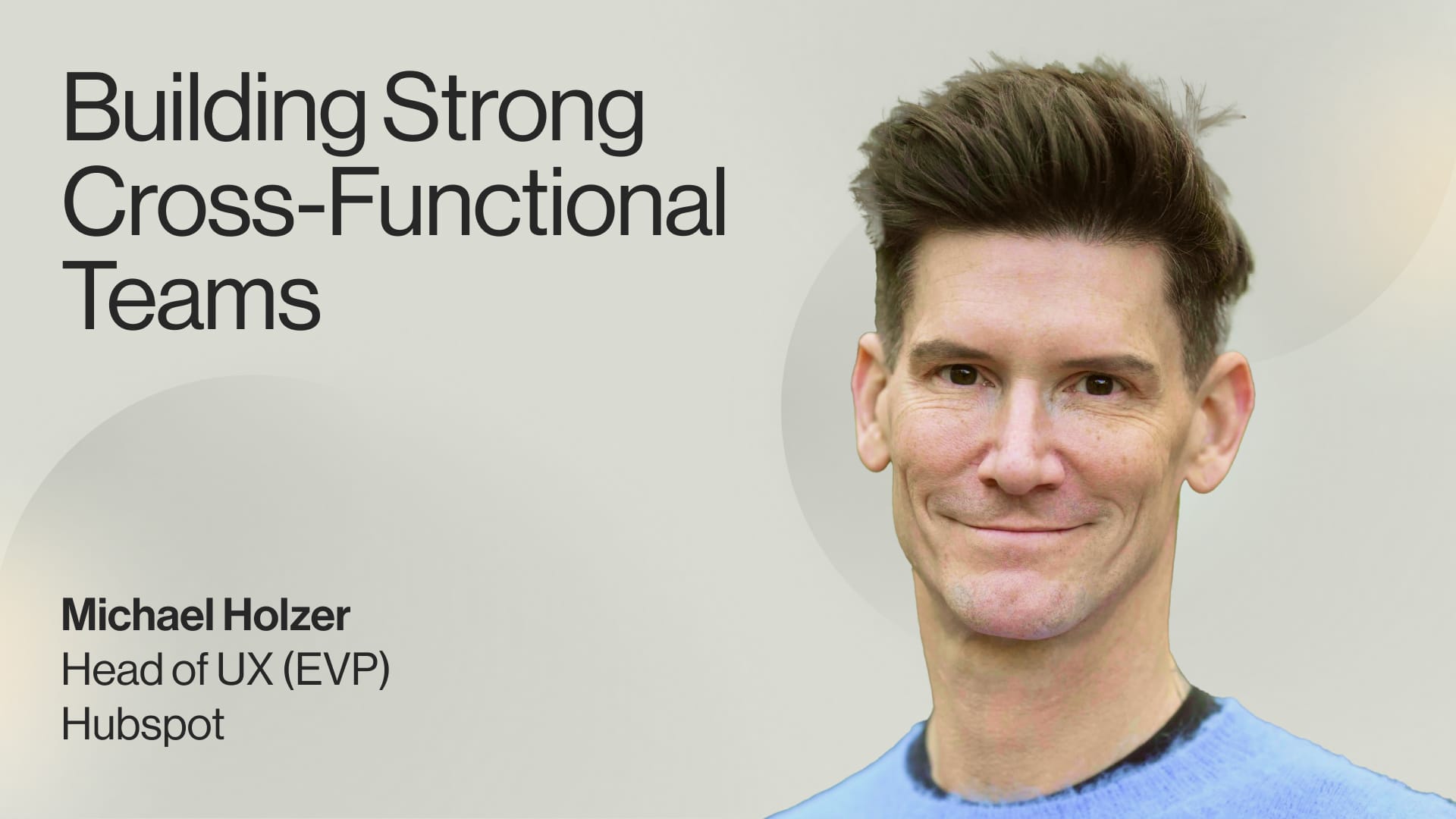
In this episode, we're joined by Michael Holzer, Head of UX (EVP) @ Hubspot. We discuss the importance of building strong relationships with cross-functional partners, and his candid thoughts on the common sentiment among UX designers of feeling undervalued.
🔴 Watch on YouTube:
🎧 Listen on Spotify:
Michael Holzer is Head of UX at HubSpot, where he leads the user experience organization across the company's CRM and marketing products. Earlier in his career he spent formative years at Google and at Opsware (the data-center automation company founded by Ben Horowitz and Marc Andreessen, which later became the namesake of Andreessen Horowitz) — both experiences that shaped his approach to cross-functional collaboration and humility.
Key Takeaways
- Michael's career thesis is that a designer's job isn't to win fights with cross-functional partners — it's to genuinely understand what they're up against. 'If you put half of those calories into understanding them, it's probably a faster route to success.'
- A lot of design-vs-product friction is self-inflicted: designers dig their heels in on methodology and craft instead of doing the plain user-centered research that would actually resolve the disagreement.
- A growth mindset isn't a soft skill at HubSpot's scale — it's operational leverage. Michael credits his Opsware years (keeping up with data-center automation he barely understood) with teaching him that the most enjoyable part of tech is the constant learning, and that the best cross-functional leaders treat every new counterpart as someone who can teach them something.
- Designers 'fought for a seat at the table' and won it in many places, but sometimes at the expense of the industry. Showing up to the table and still fighting has become a liability.
- Michael's core principle: you don't need to have a big ego about a particular project to create higher-quality products. Lower ego, higher outcomes, better relationships, better days.
- The first move when a cross-functional partner disagrees with you is not to defend the design — it's to get curious about what information they have that you don't, and to run research to settle the question.
- Design leaders who approach their partners from a position of trust rather than suspicion set the groundwork for great relationships before the first disagreement even happens.
- Humility and learning aren't modesty exercises — they're how you keep being worth hiring 10 and 20 years in.
Frequently Asked Questions
› What does Michael Holzer do at HubSpot?
Michael Holzer is Head of UX at HubSpot, where he leads the user experience organization across HubSpot's CRM, marketing, sales, and service products — working across engineering, product, and research counterparts to build cross-functional teams that actually ship.
› What's Michael Holzer's approach to working with cross-functional partners?
Start with curiosity, not defensiveness. Michael says he's never been more successful by picking a fight with a cross-functional partner; the right move when you disagree is to do research, bring data, and take a user-centered approach that doesn't require either side to 'win.' He describes his method as 'literally just taking a user-centered approach with my cross-functional board' — and is baffled when other UX peers refuse to do that basic work.
› Why do product designers sometimes feel undervalued in their roles?
Michael's candid take is that some of it is self-inflicted. When designers dig their heels in on 'you don't understand design, you don't understand research methodology,' they fail to invest the equivalent energy in understanding what their cross-functional partners are up against. That disconnect is what makes designers feel undervalued — they're often not actually being invited into the conversations where business decisions are made, because they've signaled they'd rather debate than collaborate.
› How did Michael Holzer's experience at Opsware shape his leadership style?
Opsware was a data-center automation company that became Andreessen Horowitz's namesake after HP acquired it. Michael describes being 'way out of my league' trying to understand the complexity of data-center automation early in his career. That environment taught him the value of treating learning as the best part of the job — and of being humble in front of people who know things you don't. Those lessons carried into his Google years and eventually HubSpot.
› How do you advocate for the best customer experience without alienating cross-functional partners?
Michael's view: your role in the org is still to push for the best experience for customers — that doesn't change. But advocacy doesn't have to mean confrontation. You can disagree and still ask 'what would we need to see to be more confident about this decision?' and run that research together. Making the disagreement a joint investigation rather than a political fight is what gets you a better outcome and a better relationship.
› How does HubSpot's UX team foster strong cross-functional relationships?
By hiring and developing designers who lead with trust and a learning mindset, not with ego about their craft. Michael frames it as laying the groundwork before the first disagreement: if your cross-functional partners already trust that your team is curious and collaborative, the first time you say 'I think we should do more research here' it lands as a helpful contribution rather than a delay tactic.
› What's the biggest mindset shift Michael recommends for design leaders?
Move from a 'defend my discipline' mindset to a growth mindset. The best design leaders he's worked with are constantly learning from their cross-functional counterparts instead of constantly teaching them. That shift alone resolves most of the friction designers complain about.
› What's a common mistake design leaders make when advocating for their team?
Overloading their advocacy with craft language that their partners don't share. Michael prefers grounding advocacy in the problem you're trying to solve for the user and in what the business is trying to achieve — then letting the design decision be an answer to that shared question, not a unilateral one.
Full Transcript
› Read the full conversation transcript
what baffles me about that is I'm just doing research like I'm literally just taking a user centered approach with my cross functional board this is a rocket science and yet I find that so many ux piers are dig their heels in so far on like but you don't understand me and you don't understand design and you don't understand you know a research methodology or you don't you know and it's just candly it's like me us and I'll just say that if you put like half of those calories into understanding them and what they're up against and what they're trying to you know juggle and value and it's probably a faster route to success hello everybody and welcome to how we scaled it for design teams a show that explores the journey through the arduous Road of growing a successful design practice I'm your host Adam Peis founder and CEO of Academy the ux Staffing and recruiting agency and today we have pleasure of speaking with Michael holer head of ux HubSpot in this episode we'll explore the importance of fostering strong relationships with cross functional teams along with Michael's candid insights on why many product designers often feel undervalued in their roles but before we do that if you enjoy this content please take two seconds to like And subscribe on our YouTube and Spotify channels didn't mean a lot without further Ado welcome Michael hey Adam thanks for having me appreciate being here I've seen a bunch of the other names on this podcast and I'm I'm humbled I probably don't don't deserve to be a excite a lot of them but I'm happy to be here to have a conversation about scaling design teams for sure something I love doing amazing well I forcefully disagree with that I think you absolutely have earned your keep among those names we're very excited to have you and especially you know being the head of ux for such an amazing product I think a lot of folks use out there in the business World so actually it's a great place to start is really to hear about that amazing journey I'd love to hear about your early career all the way through this awesome role that you have now as the head of ux exit HubSpot and you know I think that framing really helps our audience understand you know who you are and how you got to this place sure yeah so I always ask people when they ask me like how far back exactly do you want me to zoom back because I can go backs but I do think it's for me the I had a very hard time with school sitting behind a desk was not really my jam that wasn't How I Learned so I kept sort of dropping out of school and finding jobs that were just more interesting more intriguing better way for me to learn so the first one I started was more in the industrial design space and I did model making for a bicycle company called Bell Sports and got to do model making for like bicycle helmets bicycle pumps things like that and even that first sort of design job for me was like it just made a huge imprint on how I think about design even today because when you're thinking about bicycle helmets the material matters you can't like it's a no failure design case can't wear a bicycle helmet and have it not protect your head when you fall I'm still a cyclist to this day so wear everybody wear a helmet please but it it's where I first sort of learned this relationship between the material and the design and the Aesthetics and Form and Function and this was like I was really young so I had I had arguably no business doing this doing this work and then I left and then I went back to school tried again and then left College again and got into landscape architecture I was designing like Commercial Irrigation systems and somehow that led into skate park design so this was back when cities were hiring landscape architecture firms to they're effectively trying to get kids to stop thrashing the cities by skating all over the cities so they were like oh well if we build a skate park the kids will go there we'll stop you know ruining the curbs and all the infrastructure of the cities so I actually used some of my model making skills there and we started building like little mini models of these skate parks and take him to cities and C things would approve him that way and that was also super fun and pure luck and privilege I don't know what you want to call it and that company that I was working for and this is super it was like you know eight or nine people a small firm but the web started to take off and they were like oh hey we need a website like what is this thing and so I was like cool I'll I'll try to figure it out and I was hooked at that point I' I've been digital ever since arguably outside of I don't know designing I designed a couch this last weekend I won't go into why but I did the leap into digital just that turnaround of like being Technical and being creative at the same time and being able to kind of os back between those two things and that turnaround time like I was hooked so I you know worked at big companies small companies spent time in startups I did go at startups and spent I think it was probably four or five years as a product manager I think this is good for everybody to know I'm sure there are tons of your listeners who are designers uxers researchers content designers what have you that were like I think produ managers get to make the important decisions and I'm going to go be a product manager and I was I was one of you and I did that and I tried it and I'm happy to talk to anybody that wants to talk about it was a very good experience and there's a reason why I came back to design that's what I can say so anyway startups and then I decided to go back to design and join Google and I spent 10 years at Google and I think that's where I really formulated how to scale design games how to scale period like you don't you don't get to spend time at Google and not think about scale like you just don't it doesn't matter whether it's the software how to think about customers how to think about design and Design Systems like whatever it is like you are forced to think about scale which can also be a drag on the system like it's expensive it's hard it takes long time Etc it was fun and so I worked in four different product areas across Google and after 10 years the short version is I was like I am so ingrained and I have had so much Google Kool-Aid that if I don't leave now I don't know that I'll ever be able to work anywhere else and it wasn't because I was mad of Google or tired of Google or anything like that like I had a terrific time there it was a great company to work for and so I just you know started lightly interviewing and made the leap to HubSpot it's it's almost exactly it'll be two years I think in a week and it's been a hell of a ride and so I guess I will say one of the one of the other things because it does relate to sort of the topic ah hand at scaling design FES at Google I worked on design ladders and ux hiring at Google so it kind of across the whole organization but when you're there you're always a player in ass system like you're a cog like make no M mistake about it like it you just are it and so when coming over to HubSpot and being able to lead the whole ux team I knew the job was going to be different I knew that I was going to have more accountability and more responsibility or control to make changes in the culture and the organization the way we ran things that I'd wanted to do in the past at other companies and that was enticing W that's wow that is super interesting I love that you made that parallel because you know I think sometimes people will think about a place as big as HubSpot and you know certainly they're not everybody knows that like HubSpot is not as big a company as Google but that kind of mental shift that happens when becoming a design leader at a certain type of company at a certain stage where they're at are actually two very different paradigms that you need to think about at Google you're not going to be able to drive probably a lot of the cultural things maybe with your own team some things but not in the way that you'd be able to do at a place like HubSpot and I think that was a really interesting and nice framing as people start to think about navigating what the next step is in their career if they are going to be ahead of design somewhere what a what is the difference between going between one of those two types of ORS and there'll be there's other ones too right of course startup has a much different vibe than you know hopspot but but yeah that's an incredible journey and it was great to hear how you went from designing skate parks and bike helmets to somehow leading some of the top organizations in the world and design and having a brief stint in product management apparently yeah it was fun so yeah I and I think that's also interesting for people to hear that you know hey there's there's opportunities to change right change direction and pivot and you know it sounds like that you did a few times actually to get to the place where you really wanted to go so you know one of the things that you and I you are set talk about today is really something that seems to be foundational to you at HubSpot and the success that you've had there which is you know your partnership with cross functional teams and I think one of the biggest gripes across the industry is the fraught relationship and the frankly the mistrust at times that exists between a lot of cross functional teams and partners and I'd love to hear a little bit about your experience and how you've been able to bridge that Gap you know with your partners there or even in other places you've worked sure yeah I think is it I part of the reason why I even included the sort of upfront that connection of material and understanding the engineering of you know bicycle helmets when I first started was just it cemented this so when I was just learning about bicycle helmets and the physics of it and everything I got to partner with mechanical engineers who were doing stress tests and these kind of things just on like what happened when you fall and so I mean obviously those were super formative years for me thinking about design but the this like partnership between me wanting to push the boundaries on creativity and design and what could have look like and what could it feel like and you know but needing it to back into that function and has always been a reality for me of design work I think it's I like that practicality I do like I really like the tension between how far you can push something and it still be very useful very functional and very practical CO as a solution I think that's where I've I've oscillated between consumer and BB products as well I think they're both super fun to work on for the record that's one other thing I'll just throw out there is that I've found that sometimes people that work on B2B think the consumer is easy and people that work on consumer I think the B2B is easier and like they're both hard they're just hard for totally different reasons so make no mistake I don't think anybody has it easy in software period anybody but the those cross functional Partnerships have just been for to how I think great products end up in people's hands and when I was at Google and I would talk to other people in the industry and my peers at other companies and these kind of things and you know I think in the industry a lot of people know that there are varying degrees of where like what sort of power Dynamic does ux or design habit of giving company and that sort of changes and that often changes over time and but one of the decisions I remember consciously making when I joined Google was like Google has some of the best engine on the planet it turns out I'm not very good at writing code so if I want if I want the best experiences for the customers that I support to be shipped it's very helpful for me to have the best Engineers working side by side with me and it and it helped it's true it totally helped like working with them was a treat and same can be said for the product managers that I worked with over there and the product marketers and everybody else like the I was inspired by them they pushed design I pushed engineering it you know it's like that it just created this environment for everybody pushing each other and so that also started early on in you know time I spent to Yahoo and the time I spent at opsware and I feel like it's always been a Cornerstone of how I've approached the job is everybody has a different viewpoint on the problem and let's Embrace those different viewpoints and create that tension and out the other side of that tension is the best product possible for the customer that's the short of it I think the inspiration that I have found from cross functional Partners primarily product managers and Engineers has probably been the most formative of anything in my career and I think it's because they think about the problem differently they're just coming from a different point of view and I'm curious and I'm always like oh well okay like what if what if I thought about the problem from that perspective would I have would I have a different solution from a design perspective maybe but it's at least worth thinking about does that make sense at all yeah absolutely does I mean I think the parts that I took away that kind of were the most valuable are that you know when you when you got to Google you started to feel a bit humbled by the fact that you had these amazing you know amazing Partners who are clearly you know the best in the world at what they did they wouldn't be at Google otherwise right and so you said you know what I need to maybe take a mental shift here in terms of my approach to this and allow them to you know lead in their own ways and listen to them and try to have a much more collaborative discussion about the things the decisions we're going to make for a product because I trust them I trust them because they're the best in the world what they do and it sounds like that shift has really helped you go into all situations no matter what team whether it's Google or not right take a much different lends an approach to your collaboration with those folks and from the beginning lead with that trust so that you can hear their perspective and immediately challenge your own assumptions about a particular project and not have a big ego about it and that's led to creating higher quality products it's led to better relationships with your counterparts and and frankly a better experience for yourself because you're you're going to be a lot happier if you're not constantly at battle with another apartment right is that a good summary of kind of like your perspective and approach definitely I would say it started as soon as you said like the sort of being humbl at Google part by the engineers there I was like well wait a minute it started way before that why and I just because I don't mention it doesn't mean that I wasn't humbled by people at that company but I definitely have like very sharp memories of opsware so for those that don't know who opsware is opsware loudcloud was a hosting company that turned into opsware and opsware slow sold to HP I can't even remember when but Ben Horowitz was the CEO of opsware and Mark Andre was the chairman of the board so when they sold HP it became Andre and Horowitz the VC but and this was a very long time ago and the I was so out of my leate at this company like trying to keep up with the complexity of data center automation at that point in my career just even under understanding it yeah I was just trying to hang on to understanding it that the other thing that you said that was really resonated with me was the this is totally selfish which is I learned like I was like learning the whole time that I was doing this like it was so fun like I don't know for me like learning it learning something new whether it's a new industry a new space a new technology whatever it is like the most enjoyable part of I think being in technology it's what's kept me here is that it's ever evolving I mean scary times but so anytime that I can find people that will teach me new things like I'm in so that's I think that's beautiful I mean the that connection between this kind of learning mindset really growth mindset and you know that kind of humbling experience that you had at opsware and how that kind of led into your formative experience at Google and helping you know really Foster those cross collaboration cross functional collaborations which were pretty much Essential to your to your work there I think is a great framing great mindset for people for any leader who is starting to either be at odds with their cross functional Partners or just trying to do you know to work on those relationships I think it's really important that they start to think about their mindset think about how a growth mindset or a learning mindset and also a go from a perspective of trust mindset can really help be the laying the groundwork for great relationships I think is a really really good lesson and take away from this one of the things I want to want to Pivot to is you and I have spoken a little bit about you know really the value of a designer today and I think in the past there's been this relationship between design maybe the rest of the orb that has been a constant you know uphill battle I think designers for a long time have been fighting for their seat at the table and and they got it in many places which is fantastic you know I think it's great for the industry but at sometimes at the at their own expense or at the industry's expense and you had some hot takes on you know on this and I'd love for you to share some of those perspectives with with our audience sure I think I can a little bit connected to the previous conversation in that I'll I'll start by saying I'm not sure that the guy will always push for the best design the best experience for the customers like that's my role in the organization having said that I don't think I've ever myself in my career or on behalf of the organization that I'm leading been more successful by picking a fight cross functional part right like that's that's never led to like a better outcome and the starting place of like okay let's say we don't agree about these things if we can start from a place of what of me trying to understand where you're coming from what are how are you incentivized what different things are you like let's say you're a product manager like what things are you juggling that I am not aware of like Let's ignore the things the million things that I juggling that you're not aware of just ignore it for a minute and I'm just focusing on you and what you juggling and what is most important to you and what is most important like your job lad and everything else to me that is far more interesting and far more deserving of my attention than me being all spun up about the million things that I think are most important it because like we're more likely to move the conversation forward I'm more likely to learn something we're more likely to connect on something and find the middle ground it's just like it and I'll say what baffles me about that is I'm just doing research like I'm literally just taking a user centered approach with my cross functional Partners this is rocket science and yet I find that so many uxers are dig their heels in so far on like but you don't understand me and you don't understand design and you don't understand you know a research methodology or you don't you know and it's just candidly it's like me us and I'll just say that if you put like half of those calories into understanding them and what they're up against and what they're trying to you know juggle and value and it's probably a faster route to success faster route to certainly being happy because I spent a lot I you know it's not like I haven't spend my fair share of years being the pissed off ux or the world doesn't get me certainly wasn't happy like I like I ultimately felt like it's one of those the sort of canonical situation where you're like you know you and me are angry at each other and you decided to you know you're like I'm over it I don't care and but I'm holding a grudge well like that's only hurting me so I that has more or less been my angle and I guess my pitch to uxas in the industry which is like can we just we just hit a pause button and continue to learn about all the facets that go into software development and how we can be additive I know it's easier said than done and like I'm not saying that we don't add a ton of value and that we're always fighting the good fight and trying to get you know either a seat at the table or when we do have a seat at the table making the most of it I think my push is just that let's not do it at the co cost of our own happiness and our own learning and our own success because again what I've never had success in my entire career is complaining about having a seat at the table never like I've never complained about it and then like the PM across the table's been like you're right here to my bad here you go why don't you come in tomorrow and just tell us all what to do like never happened once right I just love this take so much it's so it's so honest because and I think you know the it was a good fight and we continue to have it as a as an industry right I think it's important to not lose sight that it is still important that design continue to be valued in organizations and I do have some followup questions on how but I want to just come back to your main points here which were like really I just thought fantastic I think a lot of designers feel like they need to fight the good fight they need to advocate for the user always and and they and they should they should to a certain extent like that is their job and they should you know be saying that but I think what's really important with what you're saying it's like sometimes you need to let it right sometimes you need to State your opinion and can do it strongly with passion and also or passion rather and and with you know foundational backing but know when to back off and say you know what like maybe it's not the right time for this or maybe there's a business goal we need to align to here that's you know that needs to be you know maybe I need to come to an agreement with my cross functional partner or what the goal is here right and if I push too hard then I risk sacrificing this relationship with this person right where and we're not going to get to one our goals together and then two individually we're both going to walk away unhappy and so I think that's a real really important message is like kind of to know when we're pushing too hard because if you are a staunch advocate for the ux process and you will not waver from that and people are just going to see you as being inflexible and hard to work with and what you seem to be advocating for is don't be hard to work with be a team player be collaborative try to learn from others try to understand their goals and from their perspective and and as a result you'll have better relationships with them and you'll likely build better products together is that a good kind of summar sum summarization of what you were saying before I can just say that has been my experience take it or leave it it has worked reasonably well for me the yeah I'd say and I think the I guess the thing I would add is that it's the other the other the other lens to look through is how long of a how long of a view do you take on the game that we're playing so the like the canonical fight is sort of velocity versus quality for example and like we' we battle that one every day it's always a tradeoff and you know what I focus on is Clarity of tradeoffs so I just want us to know when we're making the tradeoff and then it's fine right sometimes we make the tradeoff for monetization reasons sometimes we make them for Speed to Market reasons sometimes we make them for you know complexity of implementation it's a trade on no matter what or we could literally spend the next 10 years rounding corners and getting things absolutely perfect on the experience and never ship this thing also an option but I take this like much longer view of we're on this Arc of all of us caring about the quality of experience and we're going to make slow moves all along the way and we're going to know when we're making good trade-offs and bad tradeoffs and we're going to keep a little bit of an accounting book so we just know like hey like fine we made the business decision here to make a tradeoff let's just all just talk about it we just like no judgment being placed that we did it because this is a business it is what it is and so it's like just play that longer game you don't have to win every single fight for quality over velocity you just at like at the end of the game you do want to create the best experience aible for your users and help everyone understand the value that a better experience can have on the brand and the product and the experience and the customer and the customer value that adds over time and the business metrics that good ux can move you know it's like slowly but surely indeed and I know we're coming up on time but I wanted to follow up with one important question on the same you know kind of track which is you know obviously you know your advice is to you know not push too hard on those battles right like you should advocate for yourself and the user but like no one where the line is when do you think it's time to advocate for design having that seat at the table is that inside of the organization is that outside the organization through thought leadership or meetings or you know is that during those is it building those cross functional Partnerships you know and that actually by way of like just building better relationships actually that leads to design being more highly considered and more valued because you're a thought partner you know what is it for you definitely the louder hands down like I it's it's entire it's very it's very dependent on the organization it's very dependent on the team it's very I think sometimes HubSpot has a very strong culture of PM ux and Engineering being this really strong like three-legged stool it's almost like the default structure of teams which is super helpful and when I when I first came in to the organization and learned that I was like woohoo like we already won the first part of leg of the race here this is awesome the so I think it depends on where you actually is in the organization like where you want to play but I feel like there's there's no risk in going investing in those cross functional relationships because you can always influence through those because if let's say ux is doesn't have the power in the organization right now well chances are pretty high one of those two other folks do so to the that you can help influence through them and they start to trust you trust your instincts and Trust the value you're bringing they'll start bringing you into those things they'll start paring the things you're saying which also don't don't get attached to ideas coming from you be willing to who get anybody to say anything that will lead to a better experience that's my other but I think investing in those relationships early often and do think about it selfishly like think about all the things that you're going to learn from them you will be better for it absolutely that's a great place to end Michael I can't thank you enough for spending the time with us to talk about this subject I think our audience is going to get a ton of value out of this considering this is like one of the biggest issues that they face as design leaders especially if they're scaling their teams if people want to follow alone with you know anything about you or your content what's the best place to kind of like you know see more about yeah this is where I kind of not good at this part of my job which is you know I'm I'm generally an introvert and so I don't I get energy by Building Products that's where I spend my time but I would say follow me on LinkedIn if I'm GNA if I'm going to post things it's going to be there yeah hopefully one day I'll get back to writing on medium and everything else totally well certainly we'll be following along with the products you guys are building you know you guys get an amazing team and an amazing product we building over at HubSpot we we've been users for many years over at Academy so incredible well thanks again for spending the time and hopefully we'll see you again soon yeah thanks for having me ad appreciate it