Podcast: Christina Goldschmidt, VP & Head of Product Design @ Etsy — 9 Pillars of Scaling Your UX Team
Learn how Christina Goldschmidt, VP & Head of Product Design @ Etsy, fosters culture, aligns goals with vision, and builds high-performing teams

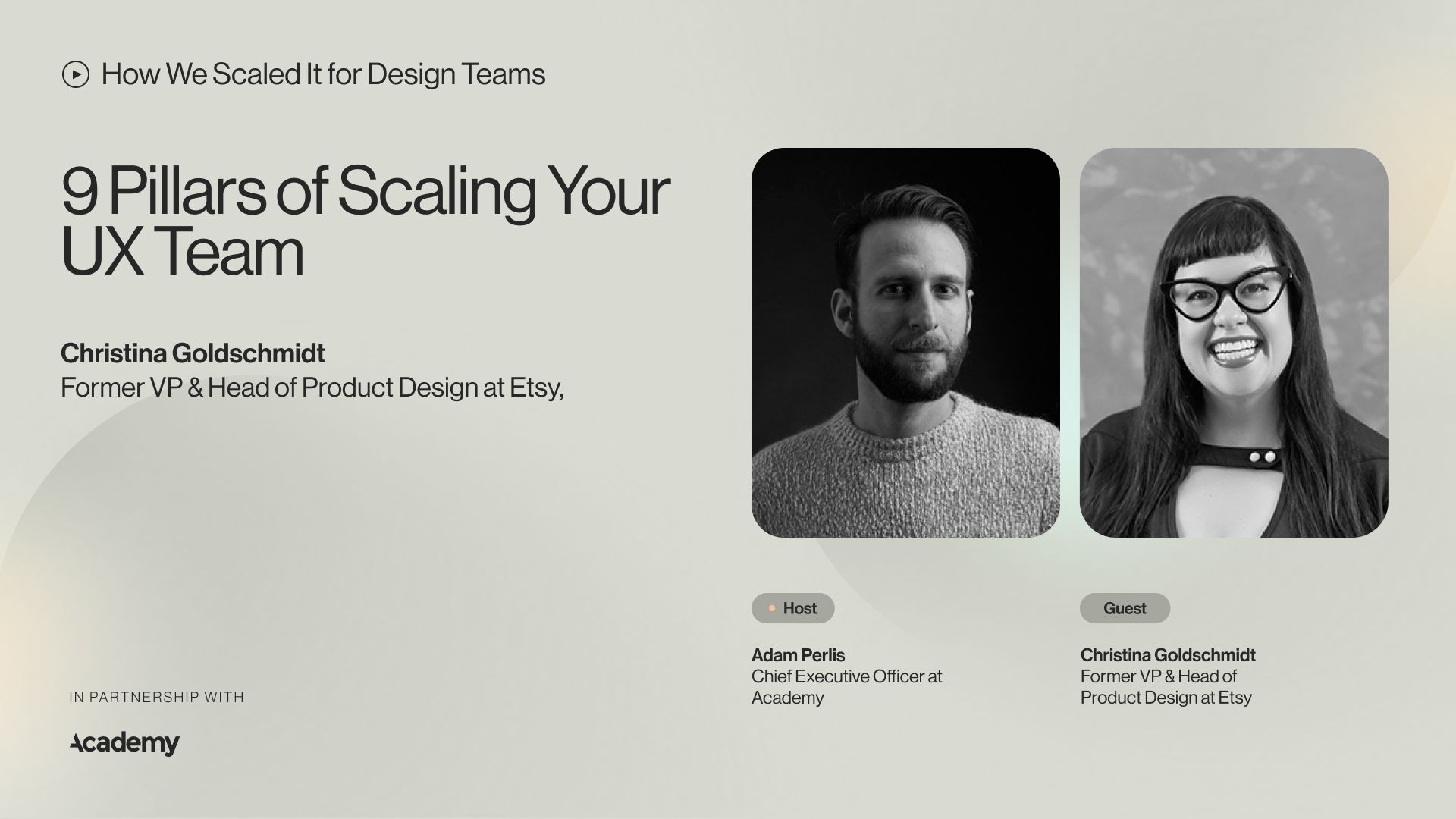
Guest: Christina Goldschmidt, VP & Head of Product Design @ Etsy
Host: Adam Perlis, CEO at Academy UX
In this episode, we speak with Christina Goldschmidt, VP & Head of Product Design at Etsy. We discuss the nine pillars of scaling your UX team. Christina shares her experiences and insights on how to build a strong design culture, align business goals with design vision, and create high-performing teams. Whether you're a design leader or a member of a growing UX team, this episode offers valuable insights into how to scale your team for success.
👉 cgoldschmidt.com
 Academy
Useful Links
- Invision’s Design Maturity Report
- DVF Model
- Design Team Vision Statements
- Org Design for Design Orgs
- Ratios
- Career Ladders
- Partnering with Recruiting
- Design Apprenticeships
- Coaching
- Business skills and training: d.MBA
- Design MBA
- Second Wave Dive
- DesignDept
👉 Want more content like this? Sign Up for the Academy Resources newsletter where we provide tools, resources, and industry expertise on all things UX to help industry leaders, teams, and talent thrive: https://blog.academyux.com/
👉 Struggling to find the right UX talent? Academy is a product design agency built around flexible resources. Whether you need a studio team, a few resources or want to find a full-time person we are a one stop shop whatever stage you are in. https://academyux.com/
Christina Goldschmidt is VP and Head of Product Design at Etsy. She has been working in digital for 25 years, starting as a front-end developer before moving into design, and has led design teams at Discovery Channel, Accenture, Morgan Stanley, American Express, and Omnicom Media Group. She is an outspoken advocate for mental health in the workplace, teaches and guest-lectures (including at NYU, where she earned her MBA), and developed her 'Nine Pillars' framework for scaling UX teams from her experience at Accenture incubating Fortune 500 ventures.
Key Takeaways
- Christina's Nine Pillars framework for scaling UX teams was developed at Accenture, where she repeatedly stood up design teams for newly-incubated Fortune 500 ventures — a high-repetition environment that forced her to turn one-off instincts into a reusable playbook.
- Great design teams embed recruiting partners inside the team — inviting them to rituals, all-hands, and in-person gatherings — instead of treating them as an external service. When recruiters feel part of the culture, the quality of candidates they surface goes up dramatically.
- The fastest way to scale a recruiter's design intuition is to mark up LinkedIn profiles and resumes together, flagging what's signal and what's noise. That on-the-job calibration beats any formal 'what is UX' training.
- Christina actively advocates for mental health in the workplace and teaches managers to lead from a place of authenticity. Destigmatizing mental health is central to how she builds high-performing design cultures.
- Onboarding is a critical pillar. Teams in the weeds of daily work routinely fail to build onboarding for the next hire — which compounds the problem when the new person lands and can't ramp, creating even more load on the leader.
- Career ladders, values, and onboarding process should be defined early — ideally before the team is forced to react. Christina has seen both paths and the proactive version saves everyone months of pain.
- Her Fortune 500 journey (Discovery, Accenture, Morgan Stanley, American Express, Omnicom Media Group) gave her a breadth of scaling contexts no single-company path would have produced, and that breadth is what the Nine Pillars framework distills.
- Aligning business goals with design vision is the first pillar for a reason — without a shared vision of what success looks like for the business, no design team can credibly claim it's adding value, no matter how good the craft.
Frequently Asked Questions
› Who is Christina Goldschmidt?
Christina Goldschmidt is VP and Head of Product Design at Etsy. She has 25 years in digital, starting as a front-end developer before transitioning into design. Before Etsy she led design at Discovery Channel, Accenture, Morgan Stanley, American Express, and Omnicom Media Group. She holds an MBA from NYU, teaches and guest-lectures, and is a workplace mental health advocate.
› What are the Nine Pillars of scaling a UX team?
Christina's Nine Pillars framework came out of her time at Accenture, where she repeatedly stood up design teams for newly-incubated Fortune 500 ventures and had to turn one-off wins into a repeatable process. The pillars cover vision alignment with business goals, team culture, hiring and recruiting partnerships, onboarding, career ladders, rituals, craft, cross-functional collaboration, and performance — the joint architecture of a scalable UX organization.
› How do you build a good working relationship with recruiters as a design leader?
Christina's approach is to embed recruiters inside the design team's culture. She invites recruiting partners to design rituals, all-hands meetings, and in-person gatherings so they meet the people they helped hire and feel rewarded for good work. When a candidate arrives, Christina will also mark up their LinkedIn or resume together with the recruiter, walking through what's signal and what's noise, which is the fastest way to scale a recruiter's design intuition.
› Do you need to train recruiters on UX?
Christina says she rarely has to run formal training but will if needed. More often she invites recruiters into design crits, team rituals, and sometimes even introductory UX courses to audit vocabulary and methodology. She's seen recruiters proactively take UX classes to improve their calibration, and always welcomes that.
› Why is onboarding so important at scale?
Because when a team is already deep in the weeds of its daily work, it routinely fails to build the onboarding a new hire needs to ramp — and that creates even more load on the design leader who then has to absorb the failed ramp. Christina recommends building onboarding before you need it, while the team still has the margin to think clearly about what a new person should learn in their first 30, 60, and 90 days.
› What role does mental health play in Christina's leadership philosophy?
Central. Christina is an active advocate for mental health in the workplace and uses that advocacy to coach managers toward leading with authenticity. She's particularly focused on destigmatizing mental health conversations — framing them as a normal leadership practice rather than an edge case.
› What did Christina Goldschmidt do at Accenture?
At Accenture, Christina led design for new ventures incubated for Fortune 500 clients — the team would start a company, test whether it was viable, and then grow it to scale. That high-repetition environment, across many industries and starting conditions, is where the Nine Pillars framework first took shape as a deliberately reusable scaling playbook.
› How should design leaders align design vision with business goals?
Christina's first pillar is exactly this: alignment with business goals comes before everything else. Without a shared definition of what success means for the business, design decisions become unarguable and design value becomes uncountable. Her approach is to define the business picture jointly with product and executive partners, then let design vision and team structure flow from that shared picture.
Full Transcript
› Read the full conversation transcript
E they're not you know treating you well or it doesn't feel like they're tailoring the experience or have knowledge of the design field that's oftentimes a red flag for me and so that's that's really valuable information to get just when you're first starting to consider a role right and to be honest I've actually walked away from a job in the past because I knew that the remit of the job was actually to hire a very large team and because I didn't have an optimal experience during the recruiting process for myself it really was a signal to me that it was going to make that very important part of the job really difficult for me and so you know that's that's something that I think any design leader should consider because at some point hiring will be an aspect even if it's not the first thing that they need to do and then so on the flip side of that I think it's really important to develop a deep relationship with your recruiters because they are really there to be a partner to you and to help bring in the best talent for you and everyone that they bring in is going to contribute to the skills and the culture of your team and so I really never consider people in recruiting to be a service function or I never really try to treat them like I'm their client because that's not how you create that experience so that you are partnering to build the culture of your team or it's not how I'm giving them perfect information to get skilled up on everything they need to know in order to hire the best designers or to do it quickly or to do it at scale and so I try to embed my recruiting Partners into my team as much as possible include them in rituals include them in things like all hands even include them in-person Gatherings so that they can meet everyone they had a hand in hiring I think things like that are really important so that they know that they are part of the culture and that they get to sort of be rewarded in a sense for the good job that they're doing yeah I think that's like one of the big challenges that a lot of design leaders face is you know there's often this tenuous relationship between Recruitment and the team itself because there is this like huge knowledge Gap that often happens I'm just curious to you know if you could speak to you know any training you've ever had to do with your recruiting Partners like did you ever literally have to sit them down and be like okay like this is ux design you know this is what we do yeah I hadn't had to do that as of late in the past it's definitely happened I think but if I had to I would not have a problem doing it I think one of the things that's that I do see happening that I'm actually very interested in doing is when let's say a recruiting partner or recruiting sourcing partner will share with me a variety of candidates I have no problems marking up someone's LinkedIn profile or resume to basically say different aspects of someone's background that I think makes them a good or bad fit and where they can continue to look for other candidates in different pools that's actually something that I think can be really helpful I'm I think most of the recruiting Partners I've met really understand the fundamentals and like I said I'll invite them to join some of our rituals so that they can start to get immersed in what we do but that seems to be also something to really help them with is some of those harder to understand and tangibles of where there's you know transferable skills or transferable industries that they may not immediately go to that are that have connections that kind of type thing I like that approach I mean you know I think that a lot of design leaders may feel overwhelmed or like they don't have enough time to put together like a whole course on ux design that's like obviously a big Challenge and maybe there's a few resources you could share with your recruiting Partners to you know kind of learn the skill but I love the idea that you know the and the approach that you've taken where it's like no like let's just integrate them into it like we'll invite them to a design critique right we'll invite them to a team event right we're going and even if it's not their primary job to support design I mean a large organization like Etsy probably has some Specialists but in smaller organizations where someone might be a generalist maybe that recruiting partner tend to vote like a half hour to come join something one you know one time you know over the course of working together I think that's not a lot to ask so I love that idea I think that's a much easier approach than like we're going to give you a design education here yeah and actually you just made me think of something back when I was teaching a ux to people who were trying to switch into the career something that I saw very often was actually recruiters showing up to take those classes and I was actually always very impressed because they were there to basically scale themselves up for their jobs and I always was welcome them with open arms and you know and if they wanted to not do some of the assignments in terms of craft but were there just to truly audit it for the vocabulary and whatever they were interested in doing I was always game so that was something that I've I've seen happen in the past too that's fantastic I definitely encourage a lot of recruiters to go do exactly that you know one of the things I spoke about earlier but we didn't cover I think I think it's very important is the onboarding process in how critically important is to develop one you know especially with teams that may or may not have time to think about getting someone new on the team up to speed you know they may be so in the weeds of the work that you know when they bring someone on that person's just floundering and yeah I wanted to see if you could speak a little bit to that experience you've had in some big and small organizations yeah I agree with you it's so critical and I think sometimes people think oh my job stops at recruiting them and that designers are smart and that they will find their way but really the onboarding process means a lot and I and I think that we can actually systematize that onboarding process and learn from other designers who have joined your organization and I think this approach works at both large and small so if you're I've seen at large organizations that you can actually sort of use a design thinking process go back and interview the last you know 10 hires ask them you know maybe six months down the road what was really great where they're struggling and ask this of their manager or Partners as well and Trace back to see you know what could be improved and what could be better and what you should systematize and then use that to really start to create a program that you can hopefully use as a reputable process and try to have ways to teach the sort of culture and processes and how you do things from day one and balance that with what they need to do in their local team or what might be slightly different about what their day-to-day job would be and then I would say at a small organization what I've seen work really well is an apprenticeship model where if you find someone who has a similar job and can sort of more have them Shadow you know and you can do this a little bit at a large organization with like a buddy program or something like that but I think at a smaller organization you can learn much more by osmosis and really sort of get immersed in what someone does day to day because they may not have the volume to try and generate those insights from what's happened from the past 10 people right but if someone is able to Shadow someone they can then sort of treat it like contextual inquiry and start to ask questions why are you doing that what's going on there and then that person also their memory gets jogged when they're doing something that they don't think about to share or to write down and then you know you can start to over time ask those new hires to keep it note log and you can then try to systematize that but I feel like in a that sort of apprenticeship shadowing model can work very well in a smaller organization yeah I love that I think very similar to the approach with the recruiters you know in lieu of like having time to go do these things because it takes a lot of time to develop an onboarding process right and sometimes you're just so stuck in the work that you don't have time to do it your team doesn't have time to do it how do you kind of offload some of that work to your team in kind of delicate delegate if you will and an apprenticeship model absolutely does that because you know then this person can spend only like two hours in the day with this new person and say okay here's all the files you need they're like all here read them all come back to me with questions right and then you know over time the team starts to free up a little bit with work the resources become more formalized you can start to put treat it as a project and put it into a formal onboarding and gradually it kind of grows into a you know a proper system but I think that's a great approach for teams that are both big and small you know some who can afford the time and the resource to go do it and then some who may not be able to so I think that's fantastic yeah and also designers like to solve problems the you know someone on your team will also I guarantee you volunteer to do something they may not take on the entire thing but what you'll start to see is maybe one of the buddies at a larger organization will write something down for their new hire and then you want to grab that because you can then use that at scale later or something in that apprenticeship program maybe that list of things to read becomes something to keep as an ongoing list or maybe it's the shares our acronyms list or something like that it's going to help no matter what and someone's going to raise their hand in one way shape or form and it's just about getting it in pieces sometimes yeah absolutely and as we start to think about not just the earliest days of somebody joining a team but as they grow with your team you know one of the things that you had mentioned is professional development and the importance of giving you know people opportunities for growth can you speak to some of your experience and you know creating programs to help people grow yeah and I think similar to what I was just saying one of the things that I found to be really important is when you enlist your senior most designers to help grow your more Junior designers and I think it's also important to not make professional development a burn of just managers and the reason why I say this is because it becomes a growth opportunity for both those senior designers and those Junior designers and I don't think people think about it in that way but when you ask your senior designers to pitch in this way they then sort of can treat it like their own personal thought leadership or their own chance to grow their mentorship skills and both of those things really are fundamental for them growing as leaders and so if they have developed maybe some expertise in one particular area and now they can start to make a training or they can start to make a blog post or something like that starts to help them scale themselves like that's how you can grow in a career or if they take on the mentorship of a couple of more Junior designers that's a whole bunch of different leadership capabilities because now they're facilitating or now they're helping to solve problems on the fly or they're just revisiting things that they've done but they have to think about in an abstract way and so that really can help them other things that I've also thought about in that same fashion is you can create a guild of some of your senior leaders and now they become this basically check for maybe quality and consistency and so then you or your managers don't have to be the only ones who are basically providing that kind of critique information and so I really like that because when you can practice and teach something you actually know it more and so it becomes this really great way to grow your senior designers which is actually sometimes much harder than growing your more junior members of your team and of course in those interactions your junior members are like sponges and they're getting all the things right from all of these interactions so that works out pretty well something else that I really like to do is to send one or two people to a conference it's either you know in person or virtual either one matters but send them with the explicit task of coming back and sharing the information but they have to summarize it and contextualize it so that everything they saw share how it would really matter to your team and to your company and so if they go in with that lens they're going to come back with a true Mastery of the content and they're going to be able to like re-teach it so now they know it and they've contextualized it and also now other people who didn't get the chance to go have exposure to that same content you know and along those same lines you can actually you know you could throw an internal conference right this is something that I've done at one of my comfort past jobs as well is that we've actually put on an eternal conference where you have this ability to let your team curate content and so they get this experience to really become thought leaders in a different way and to get practice of putting on events and also to have a great dialogue I think that's also another way that a lot of people don't think about doing something but oftentimes that can be a completely free way of doing something that also brings the team together that can be really impactful too you know and then there's like sure you can go out and get external training at scale but I think that's what most people think about when you think about professional development oh yeah there's one other thing that's also worked for me at multiple places and this is for the most Junior members of your team and that's actually if you develop an apprenticeship program and so I would say that this is a little bit different than what I was talking about with that onboarding program but if you actually help someone who might be a career switcher coming out of a boot camp coming out of college you know I think we've all learned a lot about the field of design on the job learning from other great designers and that you can't just learn it all at once from one place and so making an apprenticeship program really helps someone grow in their career over time but it does that same exact thing as having those more senior practitioners give back practice management skills and really be able to teach things it's it's a great opportunity for all parts of your organization to grow yeah I find that is one of the biggest gaps in terms of hiring practices for so many companies and design teams you know I mean obviously we're all very familiar with internship programs it just feels like design somehow like missed the boat unlike the fact that should be done in nearly every single company and that's a great way to get really low-cost labor and from a more business economic standpoint and that are extraordinarily skilled upskill them and even get them in at a much lower you know Financial cost than they would have to pay someone much more senior and they've already been embedded in your teams they know the team they know the culture they know the practices right there's just all sorts of benefits of doing it's just it's kind of a shame because there is this huge gap when it comes to talent in the industry where you have all these mid and senior level people are getting hired in this very large collection of Juniors that unfortunately are just never given the opportunity and it's so hard to break into this industry and I do wish that it was a little bit easier yeah there are actually some other benefits too so if you are giving someone that opportunity they're going to stay with your team longer so it's gonna really drive for tension but also it's a way to also diversify your team you can actually really start to think about how can I bring in more diverse Talent into my company into my team into the industry that way and ultimately sometimes companies have really difficult Industries or companies to learn it's a way to also think about how can I help upskill someone within my company who might have great industry knowledge but doesn't have the same set of technical skills or might like want to do this kind of different role where you can get industry knowledge or company knowledge that you can't find somewhere else and so those are other reasons to think about doing that kind of program that I think also have really great benefits absolutely and along those same lines I mean you know one of the things I recently read was there was a company who decided to replace all of their leadership level folks with with coaches and they said that they got a 20 increase in employee happiness and efficiency I don't know exactly how they measured it but it was it was an interesting approach you know you've talked a little bit about leadership and the importance of coaching in leadership and of course apprent you know apprenticeships definitely go along with that can you speak to that a little bit more yeah I would love to read that about more about that so please share that with me afterwards I will have to track it down yes that's so fascinating but I you know but I do really believe in the power of coaching so I think that could really help sort of convince people that as a leader you should coach more right and one of the reasons why I think coaching is so important is because as a leader you basic basically have to scale yourself if you want to be successful I should not be trying to do all the things myself I should actually be trying to upskill people on my team to know things that I know combined with the amazing things that they know that are probably in a sense great skills or things that I that are you know much better than me in other places but if you can coach them and things that you know and scale yourself in that way it makes you and your team so much more powerful and that's really I think a mark of a good leader is when they realize that and that they see the that's really their role and their goal in order to make a thriving organization and I and I think that it also shows trust and it also allows you to give more autonomy to the people who are working for you and that can actually give more satisfaction and maybe that's what drove that sort of approach there is they didn't feel like their new coaching leaders were sort of making them do something but we're actually there to help support them and what they wanted to do with their own autonomous decisions plus I think when you invest in people and try to Foster this kind of idea of a learning organization it also helps people really try to be their best self yeah that's beautiful I mean I think all critically important points when you know thinking about framing your you know how people should lead within your organization and with that in mind you know one of the important things you talk about is communication and context how do you ensure that designers have access to information that they're making informed decisions that they're contributing effectively to process and how do they how do you make communication seamless between them yeah so I think Communications and context really help people do their best work and so if I'm not sharing all the things that I know or giving people the context they can't actually be autonomous right and so I really like to take again a sort of designed thinking approach here where I want to understand in my team where what their communication needs are and maybe where communication channels might be breaking down and so trying to figure that out by seeing what information isn't being disseminated through existing channels also understanding if certain complexities of certain Communications aren't being understood or maybe getting stuck certain places I think is really important and then trying to figure out if maybe certain layers or a rare an issue might be happening or if there's just places where there's too much communication right like maybe there's a wall of emails or overwhelming amounts of slacks how like how is communication happening and where is the Nuggets where are they and then how can you actually help your team basically get the signal and the noise and so that's that's been something that has been really helpful for me to figure that out and then figure out what's the right system to fix and change so I've done things that passed like maybe decided to have a weekly staff meeting with with some of the leaders both both ICS and managers because I know that they will be able to have the right context that I can give them quickly but then they can both share with the more junior team members and then so they can ask me a bunch of questions but then they can take their time when they share it with more junior members and then therefore there's also a lot more trust that they can you know share that information and that everyone has access to information that kind of type thing and so sort of making those choices of who should be sharing what information and how it should be shared all of that I think really matters and then you can decide sort of should something be formal like does this require a email from me because then it puts people at ease in a difficult time or does when something is coming out from a senior leader do I need to back that up with a slack message so that people know I'm I'm right on top of it and that they can have an informal conversation with me things like that can be really helpful so that you can really understand how information goes around and where there's anxiety in your team you know all of that matters and then I think all this ultimately goes back to that idea of business context making sure that your team knows what they need to know about the business when because that's how they're ultimately going to be able to do their job yeah that's all fantastic points I want to Pivot to another really important topic and it's actually the last of the nine pillars it's about culture can you tell us about how you build culture and how that influences retention on your team yeah I think that people come to work in a culture and that it is one of the main factors that does Drive retention right so and so again I like to fall back on that same design process right of doing interviews observing and really trying to uncover what are the really great aspects of the culture that you want to keep and heighten and also where are things that might need to be strengthened or actually put in place in the culture and so that's going to be different based on the goals of your team or what your vision is but so that's the first thing that you need to do is really try and uncover that and figure that out but places to look really start with fundamentals of sort of how we work so go look at the crit process right go look at how the work is actually getting done because that will tell you a lot about the culture are people bringing their work freely or are they afraid to share that will tell you a lot about sort of the openness of a culture or how supportive a culture is or how connected different parts of a culture is and then decide how critical it is to drive connections across teens versus in verticals in your teams and now we have to really think about more now than ever this kind of duality of in person versus remote and how you want to set intentional social activities because sometimes those things Fall by the wayside when we're in this more hybrid world they're harder to happen spontaneously and I think and I think it happens a lot easier in smaller organizations but in larger organizations you have to be really intentional about it because it can there can be pockets of culture that are different and you really need to work harder to bring all that stuff together so I one thing that I think is really interesting to consider is does your design team consider design or their cross-functional teams their first team and which is the preferred one for the environment that you're in there's no right or wrong answer right it's really dependent on that environment and and it's really the role that design plays within the company that will help you determine which one is more important so A good rule of thumb is if design is the primary thinker of the holistic customer experience then probably design should be their first team because if no one else is thinking about a holistic customer experience it's probably only design that's going to do that job and so you need to foster a community that allows that to happen naturally and without any issues and so that's a way that I like to think about that yeah wow and then fantastic yeah sorry go ahead no go ahead go ahead no I was just gonna say that it's really fantastic insight and you know it's it's great to really hear about how you know building culture you know through rituals through establishing these very clear channels for communication and really like helping people throughout their journey of growth is what sets them up to stay in your organization for the long term and you know I think a lot of the pillars that you talk to you know spoke about today we're foundational kind of in setting this culture up it's kind of like by virtue of creating all those things you're actually building the structure for the culture and yeah I think it's it's a really it's a great framework to kind of think about as a as a leader no matter what size organization you're in but you know I just wanted to kind of wrap things up first of all thank you so much for joining us today this is really a fantastic conversation I think that our community is going to get a lot of benefit whether you're a a leader you know growing a small organization or a larger Edition there's so many valuable tips that you've shared so I really appreciate your time and just wanted to thank you again for being here yeah it was my pleasure and so great to be able to have such a rich dialogue with you and I'm I'm just really appreciative Bubba thank you absolutely and for our audience is there any place that people can follow you online to hear more about your thoughts and thought leadership and also anything else you want to make the audience aware of yeah absolutely so probably the best place to follow me is on LinkedIn so my profile's under Christina gold trip and that's where I post the majority of any thought leadership or coming speaking events that kind of type thing and so I will oftentimes cross post to Twitter but who knows about that for the future but but yeah I would say LinkedIn is probably the best place and then the thing to know about next is that I'm going to be giving a keynote address at the uxpa conference on June 20th amazing well we all look forward to hearing more from you Christina thank you again for your time today and we'll look forward to speaking to you again soon wonderful thank you so much