Branding Your Team — Alex Antolino, Former Creative Director at Typeform
Attract top talent for your company by branding through culture. Listen to tips from former Typeform Creative Director Alex Antolino.

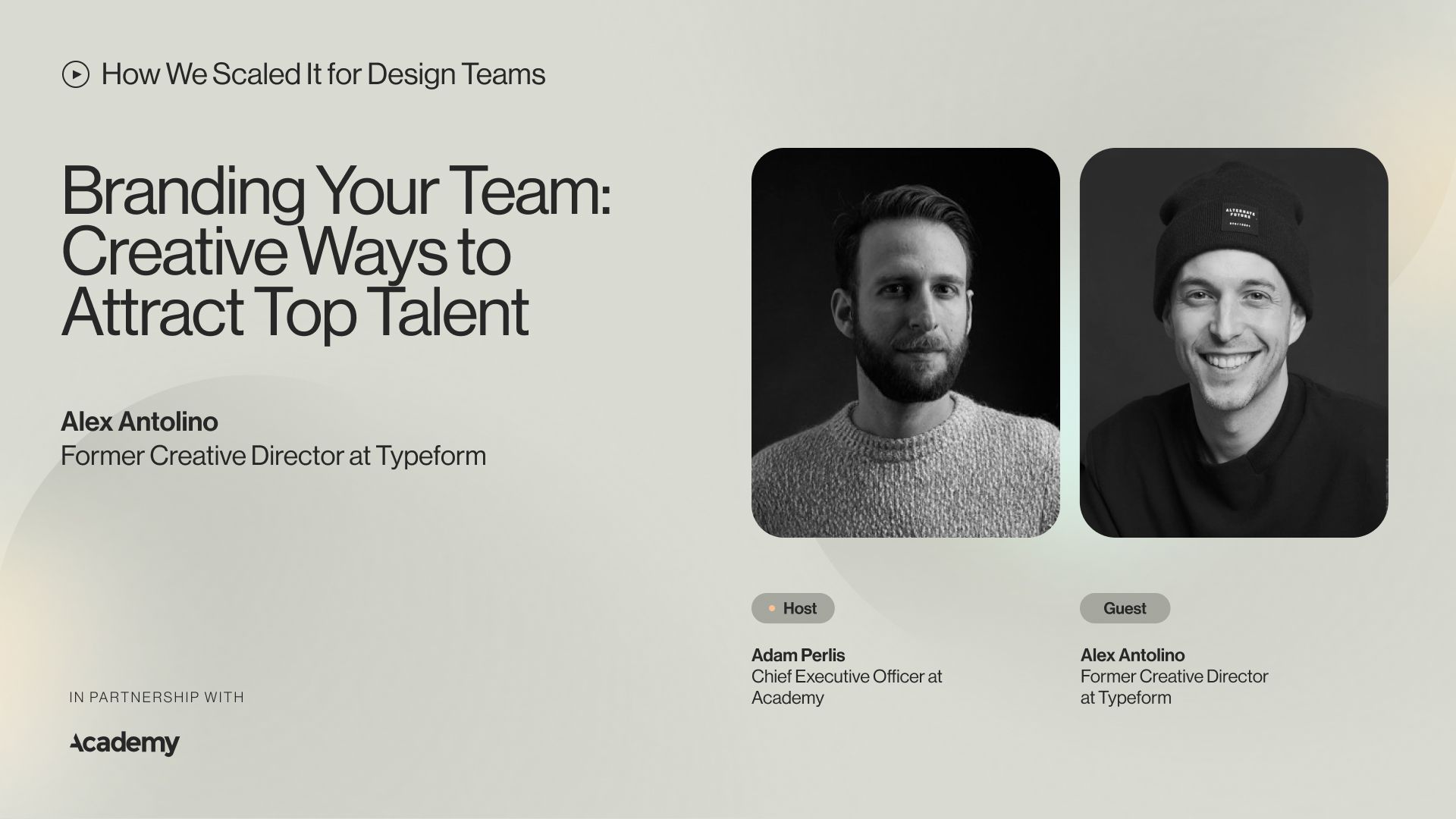
In this episode, we discuss the challenges small startups and lesser-known brands face when trying to attract top-quality talent to their team. Our guest expert, Alex Antolino, former Creative Director at Typeform shares some creative ways to stand out and brand your team to attract the best candidates. From leveraging social media to highlighting your company culture, Alex provides practical tips and insights for companies of all sizes.
Guest: Alex Antolino, Former Creative Director at Typeform
Host: Adam Perlis, CEO at Academy UX


👉 Want more content like this? Sign Up for the Academy Resources newsletter where we provide tools, resources, and industry expertise on all things UX to help industry leaders, teams, and talent thrive: https://blog.academyux.com/
👉 Struggling to find the right UX talent? Academy is a product design agency built around flexible resources. Whether you need a studio team, a few resources or want to find a full-time person we are a one stop shop whatever stage you are in. https://academyux.com/
👉 Want to hear more from Alex Antolino be sure to subscribe to his YouTube channel and follow him on LinkedIn.
Music by: ELo-Fi Fashion Chill Hip Hop | Vlog by Alex-Productions
Music promoted by http://onsound.eu/
Alex Antolino is the former Creative Director at Typeform, where he scaled the company's creative team from 1 to 15 across brand, design, and video. He now operates as a 'creative director turned creator,' partnering with brands and creators to bridge the gap between the two — teaching brands to engage like creators, and helping creators build strategic brands. He is also a mentor and brand advisor.
Key Takeaways
- Branding isn't just about attracting customers — it's about attracting top talent. Alex built Typeform's employer brand the same way he'd build a consumer brand, and treats the team itself as something worth marketing.
- At around 7-8 people, Typeform's creative team hit the 'you can't have everyone reporting to you' wall. Alex had to stop being a single-node manager and introduce internal structure — a moment every creative leader recognizes once they've been through it.
- Typeform's creative team built its own portfolio website — 'like an agency website with our best work and results' — explicitly as a recruiting tool. Every team member got a profile page with their bio, and the site doubled as a sense-of-belonging artifact for the team itself.
- When you're hiring a junior, you're evaluating attitude, interest, eye, and thought process. When you're hiring a senior, YOU'RE the one pitching — so you'd better have something to pitch with. The portfolio site was Alex's answer to that asymmetry.
- Alex set values and purpose for the team early, not as a 'spend a month going crazy on it' exercise but as a quick agreement on 'what drives this team's decisions.' Keeping values lightweight made them actually used rather than performed.
- Career ladders and interview processes were defined from the beginning at Typeform. Alex's view is that the same documentation candidates use to evaluate your company IS your culture — if your path, interview process, and expectations aren't documented, you don't have a culture, you have vibes.
- Alex's pivot from creative director to creator is deliberate: after 15 years helping big brands communicate through video and design, he realized creators are now 'rocking and rolling the brand awareness world' and decided to bridge the two.
- Alex coaches creators on brand strategy and coaches brands on how to engage like creators — a two-sided consulting practice built on the premise that the two worlds have important, currently unshared lessons for each other.
Frequently Asked Questions
› Who is Alex Antolino?
Alex Antolino is the former Creative Director at Typeform, where he built and scaled the company's creative team from one person to fifteen across brand, design, and video. He now works as a 'creative director turned creator,' partnering with brands and creators to help them learn from each other. He is also a brand advisor and mentor.
› How do you use branding to attract top design talent?
Alex's approach at Typeform was to treat the creative team's employer brand as a real brand project, not a recruiting afterthought. He built a team portfolio website — structured like an agency site, with the team's best work, clear results, and individual profile pages for each team member. The site functioned as both a recruiting asset for senior candidates (who need to be pitched on the work) and as a sense-of-belonging artifact for the team.
› When does a creative team need internal structure?
Around 7-8 people, in Alex's experience. At Typeform, he hit the wall at that size — you simply can't have everyone reporting directly to you anymore, so you have to introduce internal structure, start delegating interviews, and define career paths. The team portfolio project started around that same size, driven by the realization that Alex couldn't be the only recruiter for senior hires.
› How should you hire junior vs. senior designers?
Alex distinguishes them sharply. With juniors you're evaluating attitude, interest, passion, eye, and thought process — because the portfolio is thin by definition. With seniors, YOU are the one pitching — they are already employable and your job is to explain why your team is worth their time. Having documented work, results, and ladders to show them is what closes those conversations.
› What's the right way to define team values?
Alex's counterintuitive advice is to not spend months going crazy on values. His team defined purpose and values early, but lightweight — a quick agreement on what drives the team's decisions. Keeping it lightweight made the values actually usable in day-to-day decisions, rather than a performative deck everyone ignored.
› Why did Alex Antolino pivot from creative director to creator?
After 15 years helping big brands communicate through video, design, and advertising, Alex saw creators 'rocking and rolling the brand awareness world' in ways that rivaled the biggest brand marketing he'd ever worked on. He now positions his consulting practice on both sides — teaching creators to build strategic brands and teaching brands to engage like creators.
› What did Alex Antolino do at Typeform?
Scaled the creative team from 1 to 15, covering brand, design, and video. He built the company's visual identity, its employer brand, and its external creative output, and developed the internal structures (career ladders, interview process, onboarding, team portfolio) that made the team durable as it grew.
› What advice does Alex give to creative leaders scaling a team for the first time?
Define the basics — values, purpose, career ladders, interview process — before you need them. Use the team's own work as a recruiting asset. And when you hit the 7-8 person wall, stop trying to be the only manager and start building the internal structure that lets other people share the load.
Full Transcript
› Read the full conversation transcript
where we actually I realized that I actually needed internal structure within the team because like if it's five people they were all reporting to me it's too right when you start having more than like seven eight you're like oh my God like I can't be like it's not efficient so I was like okay what I realized is that people wanted to so kind of career ladders and all of that we had it from the very beginning so we always kept improving but like that was it that was there but then people were like okay so I realized we were doing a lot of interviews and now I'm not doing all the interviews now it's my team also doing like right Illuminati interviews and like getting to know everyone and one of the needs that they realized that we needed was that we need to show the work so we if you have a junior they might not have that much work and then you're like trying to see if they have you know a good attitude an interest a passion like some like a good eye you know what I mean like you're you're like a good thought process so you're like evaluating these things when you're hiring for engineering me positions but when you're hiring for like a senior principle you now you're the one that's also pitching right right in a way when it comes to like not just culture and like working opportunity but you're pitching now the work right so you're having a different type of conversation I would say and we realized that we needed to like explain also projects and talk about results and we're like we're not we don't have any of that like as soon as we deliver something we move on to the next thing and but we've done amazing things and so we realized that in Meetup the interview we're like trying like oh where was that link let me show you this thing cool thing that we did so we're like this is not working so we need to create a portfolio also I noticed like there was this sense of like self from fulfillment of like the media people like the design people wanting to feel like they belong to something and they're like actually creating something like cool for their portfolios for their work for the profession professional career so we think we decided to create like this website which was like an agency website with like our best work and results and feature them so they have a space like a profile page for like they put their bio and it was a like a recognition moment as well that was one of the things and it was a very exciting moment and they would work on the case studies and like it would actually realize that it made them more aware of the value of their work and another thing that we did and this has always been one of my beliefs since the first person that I had reporting to me was that I joined typeform with the idea that I wanted to make money and go travel and on the first interview I remember because it was so small as like less than 30 people I was interviewed by David and Rover their co-founders and I remember Rover asking me on the interview he was like why do you want to work here you've done like TV commercials you've done all these great work and what we're offering you is like tutorials for a tech company and I'm like and if like you're paying a lot of money I said look I've been running a business for five years I need a break so yeah I'm gonna show up to you every morning make great videos that are overly delivering to you're gonna pay me these and I'm gonna be chilled for like six months and then go travel and like save some money I'm like is it good for win for you to win for me and he was like okay oh it's a story of how I got into Thai food wow yes and wow obviously the company explode I saw the opportunity to like build something special there and I got really excited and I stayed working there for like seven years yeah but that's how it got started and one of the things that got me to stay for so much time is that I never felt that I was exclusive to them especially with like transition from having a business to like working full time I still had some like cool projects that I and I was working at Fashion it was very different from the work I was in a type form right felt more exciting far more like an adventure every like a fashion film was like very exciting and like creatively simulating to me and so I never wanted to lose that and so I it may be like on the weekends or like on the evenings I would make some like projects aside and this is something that I always wanted everyone to feel and I and that was also a good thing that I noticed like I did very well in that time then I was like I always allowed them to like work on anything because people would ask me I say hello because people were asking me like can we like I don't know like these companies like ask me like can you do a freelance with them and try so I never was protecting about that and that was one of the great things like I remember like one of my best designers she before all the time she was a type for more like two years I was a typeworm so not all the time but she was like doing these freelance work and like building a brand as a freelance and she was doing so much great work and looking at different completely different references than the ones that we were looking at as a tech company and she was bringing all that to the tech space and I was like having this like freedom of like Explorer you know this is your full time you as long as you like do the work here yes please go and do other great stuff and so that funnel in I think into like this idea of building the portfolio because like it was very express it was very created very expressive we would have the numbers there but I we built it in a way that we're like hey if you want to apply this is you who you're gonna be working with this type of work this is what we that we work with and this is what motivated us and that was one of the big things that was very exciting for people to see when they would come to the interview like oh my God I've seen this you guys do the great work because now they can go to a place and see it and see who they work with and all that stuff yeah wow that's that's amazing like I love that you've created you created kind of a house for all of this to live in and you enabled people and as you said through self-fulfillment to Showcase their best work and even other outside work it sounds like you know and I think like gave them the opportunity to shine and share the spotlight you know like I think that's like a really big thing theme that I'm hearing here and like that kind of like talks about your culture it also talks about people's work and helps them build their own stars and their careers and I think that's just such a wonderful kind of way to took on a bike help both build your team but also build up individuals and like they're actually it's almost strategic too right like they have their own networks those networks will expand and like as that as they people start to inquire about their work you know they'll start to inquire about the company and that can attract new people I love that you say this word strategic because it happens a lot with branding that I mean that's my belief in general in life and also my business work that I do and everything that I do it's like if you're if you're a good human and you are kind and you treat people with respect and you generally want the best for others things usually go well yeah so yes I don't know like this is my experience but this is something that I really wanted like I really want them to shine like if you go if you leave this company please tell me it's because Apple hired you yeah because of the work you did here see what I'm saying right like I want better compliment yeah it's a compliment so and actually some of the designers that work at diaper or one of them were like it was out of my team but I got hired at apple and like those are the things that I'm like this is great you know what I mean yeah this is the type of even I would say sometimes more than a word like these are the type of things that that's what I want and some people might be more protective and be like Oh but like we don't want them to leave I'm like well if they it is not your decision like it's their choice to do whatever they want with their career and yeah only what's on what's you're under your control as a company or as a brand or is a or as a leader a creative video design leader or whatever is just make them fall in love so they don't live here and yeah make that like that it's good for them so yeah so that's how that's always been my Approach and I really like that you say the word strategic because it is strategic sometimes it's hard to translate this to business terms or like if you're building a brand if you're putting out content like the amount of time I spend putting out content out it's a lot I generally want to build a community of people who or brands that wanna make better advertisement the respects people respects people time respects people intelligence and it's it's just I put a lot of content because I think this is like part of like education that we need to like create this new mindset of like how do we think about advertisement and like building Brands through content but sometimes it's hard right it's like oh attribution like what's the hour or why it's like well you just literally like wait and see this like this the signals like I when I left iporm or when I start working with the creative demand type form because I did a different role the last two years I realized my how you call it is this turn down there's a term for like to measure how many people live the team turn over turn over turn over it wouldn't one of the lowest of the entire company to not I don't I don't want to say the low because I like I don't remember if it was the lowest of you know what I mean but what was like I think we had two people live in five years wow that's amazing I mean that's a lot for me it was mattress like of course we're doing something good who would want to leave but then I realized no like other teams have people come and go like two months three months like a year and people I hadn't working I was I worked with them for like five years and he was amazing my friends you know I mean like yeah like I'm talking about incredible getting like excited and like I'm getting like I'm passionate about it because it was it's good to like try to do good things for other humans yeah I was gonna literally you took the words out of my mouth but I was gonna follow up and just say that the main thread here is that just treating people well is a good brand strategy and if you can just continue to kind of help others grow and put a lot of value back into their lives into their careers or even into your companies like that's just gonna pay you back in spades and sometimes in ways you are not expected right absolutely most of the time easy ways you don't expect actually I would say yeah and I it probably goes well with a lot of the clients you work with as well as you know any team that is looking to scale their own practices and develop their own you know design cultures so you know I think like some of the things kind of sum up you know some of the things we've talked about today you know what is like establishing culture really early is a good way to really communicate effectively with your teams and and not just with your teams but also with the outward world because it's really the root of all the things that you know you're building towards and hoping that your team will eventually be able to scale and scale a lot of times is a function being able to attract talent and bring the best people onto your team and in doing so you know you're developing things like team road maps career ladders interview processes onboarding processes and all these things when you know effectively communicated to the outward World whether that be on your you know company websites whether that be in blog posts that you write or social media things that you share are really important foundational things but when you look past like just the important foundational things which are a little bit more operationally focused you have to think about well how can I help this team grow right and in both personally right but and professionally and not just for the company but for themselves and that comes through self-fulfillment right and some of the techniques you'd mentioned allowing people to let their stars shine we're really resonant with me I think we'll be with other people you know in our audience and then sharing the team's success stories not just individuals but team is a great way to do that and of course lots of effective channels like social media like blog posts and and I'm sure a variety of other ways but yeah you know I think it kind of wraps up most of our discussion today but Alex I wanted to thank you so much for taking the time to chat about this and you know so people are aware where can they find you in order to learn more about your services the things that you've worked on or even ask questions you know about your work at typeform yeah so I'm on LinkedIn Instagram and YouTube so if you want to talk with me just like connect with me on LinkedIn or DM me on Instagram and if you want to learn from the things that I'm like I do like my journey and like how to build Brands and how to learn from the Creator economy just go to my YouTube like that's actually my number one Focus right now where I'm gonna putting like a good like 60 of my time to build that so if you wanna if you want to learn with me I like teach me stuff come to YouTube and like let's connect there because I think a lot of things are going to happen this year on there so yeah well I've been following your journey for quite some time really excited to see all the amazing content you're putting out I'm sure it's going to help out a lot of people as they grow their teams companies Brands and yeah I will put all those details in the show notes so that you have an Easy Link to all of Alex's socials and thank you all so much we appreciate it thank you so much for having me tune in great chat thanks Alan thanks for watching