Podcast: Peter Merholz, Design Executive and Author — How to Design Your Design Org
Scaling design teams with Peter Merholz, co-author of "Org Design for Design Orgs". Learn when to scale your team and how to structure it.

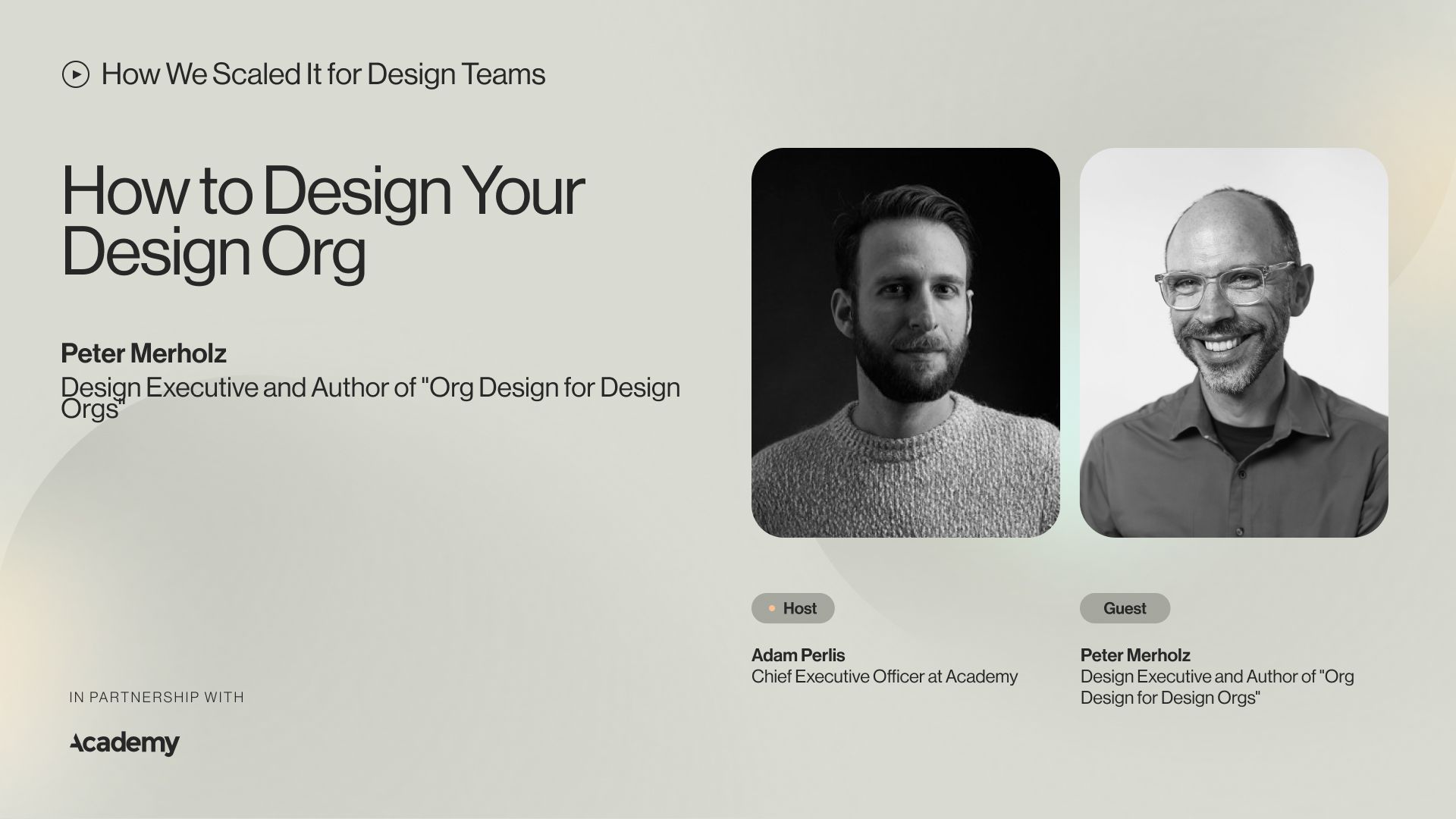
In this episode, we sit down with Peter Merholz, the co-author of “Org Design for Design Orgs”, design executive and organizational consultant, to discuss the challenges of scaling a design team, knowing when to scale and how to structure your team effectively. We also discuss the different types of team structures and their pros and cons.
🎧 Listen on Spotify
🔴 Listen on YouTube
👉 Want more content like this? Sign Up for the Academy Resources newsletter where we provide tools, resources, and industry expertise on all things UX to help industry leaders, teams, and talent thrive: https://blog.academyux.com/
👉 Struggling to find the right UX talent? Academy is a product design agency built around flexible resources. Whether you need a studio team, a few resources or want to find a full-time person we are a one stop shop whatever stage you are in. https://academyux.com/
Peter Merholz is a design executive, independent consultant, and co-author of 'Org Design for Design Orgs' — widely regarded as the handbook for scaling in-house design teams. He's been in user experience for over 25 years, co-founded the pioneering consultancy Adaptive Path, and has served as a design executive at Groupon, OpenTable, and Snagajob. He now embeds inside companies (Wells Fargo, Ceridian, JPMorgan Chase) to help them scale design, and does thought-partnership work with design leaders around the world.
Key Takeaways
- The critical inflection point for a design team is somewhere between 7 and 10 people. That's where org complexity starts compounding — recruiting, hiring, onboarding, professional development — and a design leader who absorbs all of it can no longer do the creative leadership role they were hired for.
- The second critical moment is at 20 people, when design teams typically realize they've never defined their own identity — it was defined by other people's expectations of them. That's when Peter starts recommending team charters.
- Most design teams were started organically by a non-designer (often a founder or PM) who hired one senior designer and said 'build out your team.' That origin story means the team's early identity is someone else's idea of what design should be, which is why rewriting it at 20 people is so common and so healing.
- 'Org Design for Design Orgs' (Peter's 2016 book with Kristin Skinner) is still basically the only handbook for growing in-house design teams, which is why it keeps generating consulting work seven years later.
- When design leaders are doing recruiting, career ladders, onboarding, and professional development themselves, they are literally not doing the creative leadership work the company hired them for. Design operations exists to make that trade-off conscious and fixable.
- Peter's consulting thesis: companies usually ask him to help them 'scale design,' but the actual problem is rarely headcount. It's the team's inability to own its own identity, scope, and standards inside a larger organization.
- Peter's 'Define Your Design Team' framework (Google it alongside his last name) is his go-to first exercise for any team that has hit the 20-person wall. Most teams discover they've been defined by other people's expectations, not their own.
- Peter's experience scaling Groupon from 25 to 60 designers was his formative moment. That's the scale where he first learned the practical mechanics of growing a design org — and where 'Org Design for Design Orgs' was incubated.
Frequently Asked Questions
› Who is Peter Merholz?
Peter Merholz is a design executive, consultant, and co-author of 'Org Design for Design Orgs,' widely regarded as the handbook for scaling in-house design teams. He co-founded Adaptive Path (one of the first user experience consultancies) and later ran design at Groupon, OpenTable, and Snagajob. He now embeds inside large companies — Wells Fargo, Ceridian, JPMorgan Chase — to help them scale design, and works as a thought partner to design leaders around the world.
› When should a design team start formalizing its structure?
Peter says the first inflection point is somewhere between 7 and 10 people. Below that, a single leader can hold everything in their head; above it, organizational complexity (recruiting, onboarding, professional development, ladders) starts compounding and someone needs to own those operational functions so the design leader can actually lead.
› When should a design team write a charter?
Peter recommends charters when a team hits about 20 people. That's the size where his clients consistently come to him asking 'who are we, actually?' — because up to that point, the team has usually been defined by other people's expectations (often production-level expectations) rather than by its own ambitions.
› Why do 20-person design teams usually lack a clear identity?
Because most design teams aren't founded by designers. A founder or PM decides 'we need design,' hires one senior designer, and tells that designer to build out the team. Identity gets inherited from whatever the rest of the org expected design to be — usually wireframes, mocks, and production work. At 20 people, the team has the critical mass to want to define its own role, but also discovers how much of its current identity was assigned to it.
› What is 'Org Design for Design Orgs'?
The 2016 book Peter co-authored with Kristin Skinner — still basically the only practical handbook for growing in-house design teams. Peter credits it with being the 'calling card' that has kept him in embedded consulting work for years, and recommends it (along with Chris Avore and Russ Unger's 'Liftoff') as a starting reference for design leaders scaling an org.
› What does Peter Merholz actually do as a design consultant?
Two things. First, embedded work inside companies — he's spent extended time at Wells Fargo, Ceridian, and JPMorgan Chase helping them scale their in-house design organizations. Second, thought partnership with design leaders globally, from eight-person teams to 450-person ones, across startups, tech, and financial services.
› What's Peter's 'Define Your Design Team' framework?
A blog-post framework (Google 'define your design team merholz') that he walks leaders of 20-person-plus teams through when they come to him for charter work. It starts by surfacing what the team is currently expected to do, then separates what others expect from what the team wants to own, and uses that gap as the basis for the charter.
› What was Peter Merholz's role at Groupon?
He scaled Groupon's design team from about 25 to 60 people, which he describes as one of the most formative professional experiences of his career. That experience is the primary source material for much of what later went into 'Org Design for Design Orgs.'
› What was Adaptive Path?
Adaptive Path was one of the first user experience consultancies, co-founded by Peter and his partners in 2001. Peter spent ten years helping lead the company before moving into in-house leadership roles and eventually to embedded consulting.
Full Transcript
› Read the full conversation transcript
com or on LinkedIn Peter Mir Holtz me R HZ I'm the only human on planet Earth with that name to the best of my knowledge so it's it's pretty easy to find me and I'm pretty active on LinkedIn and not just posting stuff but always love to read the comments and to engage like that's that is where I see the best conversations happening around design and ux Leadership and organizational matters yeah actually that's how I recall you and I met for the first time was I probably posted some comment on one of your posts and we started a dialogue so that's that's fantastic it's great awesome well thank you again Peter I really appreciate your time and have a wonderful rest of your week and we'll see you next time thank you YouTube My pleasure and this was fun thank you