Podcast: Designing Healthy Teams for Success — Richard Banfield, ex-VP of Design Transformation at InVision
Gain practical insights from Richard Banfield, Former VP of Design Transformation at InVision, design advisor and author. Discover how to build healthy, productive, and successful design teams.

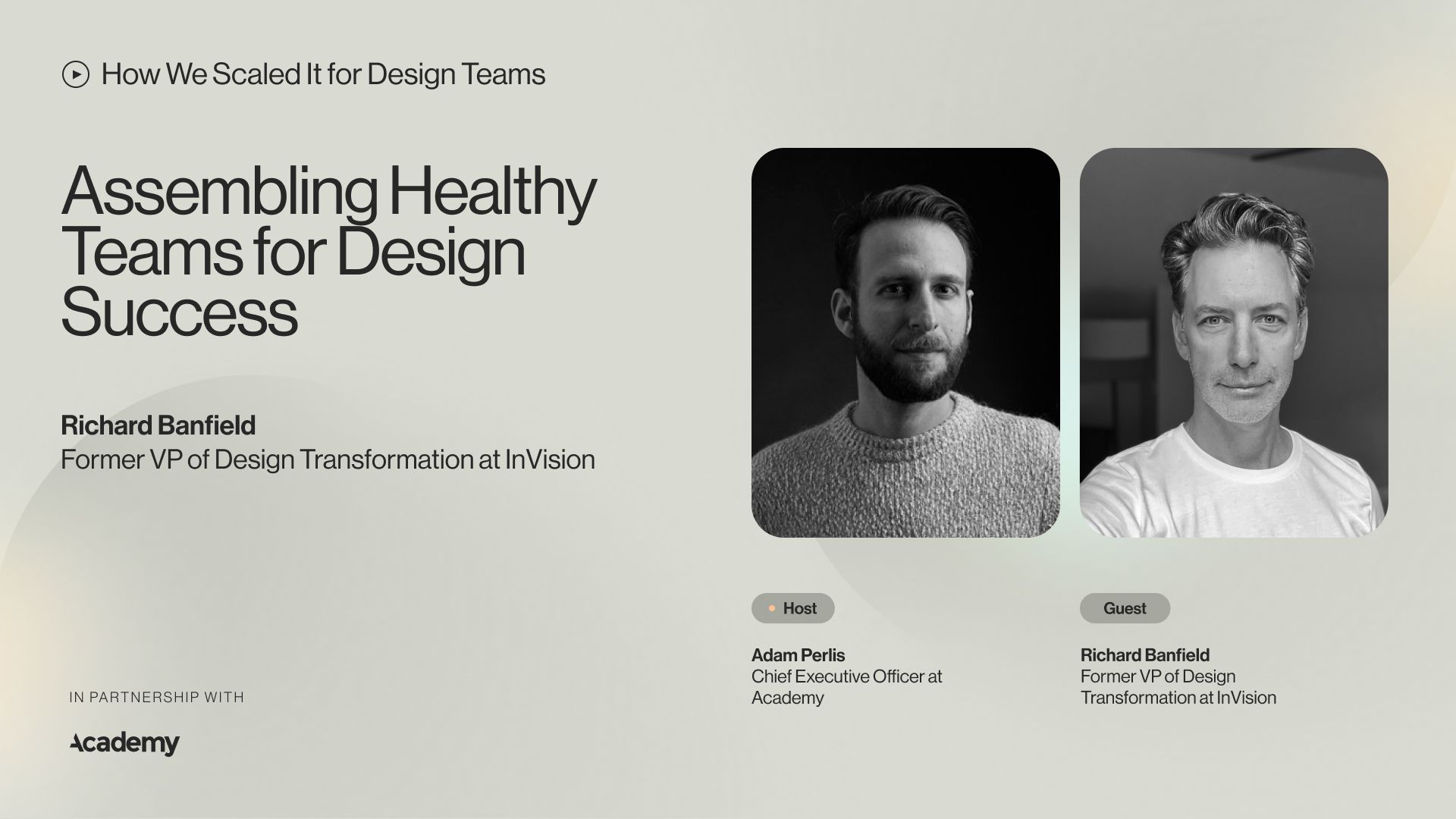
Guest: Richard Banfield, Former VP of Design Transformation at InVision
Host: Adam Perlis, CEO at Academy UX
In this podcast episode, design advisor Richard Banfield shares practical insights for design leaders on assembling healthy teams for success. Drawing from his experience as VP of Design Transformation at InVision and author of influential design books and artist, Richard offers guidance on navigating conflicts, managing stress, and other challenges. Discover how his coaching empowers leaders to create impactful designs and foster a thriving team environment. Join us for invaluable strategies and tools to achieve design success.
You can follow along with Richard's work at the following links:
🔗 https://www.linkedin.com/in/richardbanfield/
🎨 https://richardbanfieldart.com/
🤝 https://www.richardbanfield.com/
👕 https://www.domesticpropaganda.com/


👉 Want more content like this? Sign Up for the Academy Resources newsletter where we provide tools, resources, and industry expertise on all things UX to help industry leaders, teams, and talent thrive: https://blog.academyux.com/
👉 Struggling to find the right UX talent? Academy is a product design agency built around flexible resources. Whether you need a studio team, a few resources or want to find a full-time person we are a one stop shop whatever stage you are in. https://academyux.com/
Music by: ELo-Fi Fashion Chill Hip Hop | Vlog by Alex-Productions |
Music promoted by http://onsound.eu/
Richard Banfield is a design executive, author, and artist, and the former VP of Design Transformation at InVision. His career spans military leadership (he was conscripted into the South African army after high school and trained at an officer academy), running a diving school with 40 staff on a remote Indian Ocean island, and decades in tech and media. He has written multiple books on design leadership and product development, and now coaches and advises design leaders through the hardest people conversations of their careers.
Key Takeaways
- Richard's central reframe for design leaders: the team is your product. Your job is not to make design artifacts; your job is to make a team that makes the product. Leaders who don't internalize this keep trying to push pixels when they should be doing people work.
- Most designers promoted into leadership never actually wanted to manage people — they took the promotion because 'that's how HR designed the career ladder.' Richard's blunt advice: be honest with yourself and move back to a senior IC if you don't genuinely want to do people work.
- Assembling healthy teams is a series of hard conversations — about alignment, conflict, and resolution — that most new leaders avoid because hard conversations trigger shame. Richard has a painting titled 'Shame Will Kill You' for exactly this reason.
- Hard conversations don't mean mean conversations. Richard's framing is 'honest, open, meaningful conversations that expose us and let us be vulnerable in ways that move us forward' — a skill that has to be learned because most of us grew up with the opposite.
- Richard's leadership foundation started in the South African military, where he saw firsthand the shift from top-down command to radio-distributed decision-making on the ground — an early lesson in how healthy teams actually operate.
- Running a diving school on a remote Indian Ocean island with 40 staff from different languages, cultures, and religions taught Richard more about people leadership than any corporate role. 'A baptism of fire.'
- Psychological safety plus good collaborative tools are the leader's deliverables. Build the space correctly and the team will do their work; fail to build the space and no amount of talent compensates.
- If you're a leader who feels guilty every time someone on your team is unhappy with you, that guilt is the thing undermining your ability to do the job. Getting past it is the core skill of design leadership.
Frequently Asked Questions
› Who is Richard Banfield?
Richard Banfield is a design executive, author, and artist, and the former VP of Design Transformation at InVision. His path into leadership is unusual — conscripted into the South African military after high school and trained at an officer academy, then a diving instructor leading 40 staff on a remote Indian Ocean island, then tech entrepreneur and media operator, before becoming an executive in the design industry. He has written multiple books on design leadership and now coaches design leaders one-on-one.
› What does Richard Banfield mean by 'your team is your product'?
He means that design leaders often describe their product as the output (features, screens, shipping) when their actual product — the thing they make and maintain — is the team itself. The leader's job is to 'make a product (the team) that makes a product (the work).' If you're not doing people work, you're not doing the leader's job. Richard uses this reframe to force leaders to decide whether they actually want that role at all.
› Why do design leaders avoid hard conversations?
Shame. Richard says the fear of being disliked, misunderstood, or accused of being unfair is 'part of the family' for a lot of people, particularly those who grew up in shame-oriented cultures or religions. That shame keeps leaders from saying the thing that needs to be said, and unresolved conflict compounds inside the team. Richard has a painting titled 'Shame Will Kill You' that's explicitly about this pattern.
› How should a leader approach difficult conversations?
Not as mean conversations — as honest, open, meaningful ones that expose everyone to some vulnerability and allow the team to move forward. Richard frames this as a learnable skill, not a personality trait. The leaders who do this well aren't more naturally confrontational; they've decoupled 'being disliked in the moment' from 'failing as a leader.'
› What's Richard Banfield's advice for designers who become managers but don't enjoy it?
Be honest with yourself and move back into a senior IC role. Richard is direct: many designers are pushed into management because the HR career ladder gives them no other way to grow, but if you don't want to do people work — if you'd rather be pushing pixels or writing code — then management is the wrong job for you, and trying to do it without wanting to do it damages you and the team.
› How did Richard Banfield's military experience shape his leadership philosophy?
Richard was conscripted into the South African army after high school and trained at an officer academy during a period when the military was moving from top-down command to distributed decision-making on the ground. He describes that transition as his first real lens on what healthy teams look like — leaders creating the conditions for frontline people to decide, rather than trying to decide everything themselves.
› What does Richard Banfield do now?
He coaches and advises design leaders, often through the hardest people moments of their careers — conflict, reorgs, the first management job, exits. He also writes books and works as an artist. His core belief is that design leadership is fundamentally emotional labor disguised as strategy, and that most leaders don't get the support they need for the emotional part.
› What's the biggest mistake new design managers make?
Trying to keep doing the practitioner work they were good at while also trying to do the people work they've never been trained for. Richard's prescription: pick. If you pick management, commit to making the team your product — psychological safety, hard conversations, resolution — and let the team do the practitioner work.
Full Transcript
› Read the full conversation transcript
com if you want to see my paintings and the other work that I'm I'm doing creatively so those are the best places to find me and you can you can sign up I'll I'll start publishing a newsletter soon well something like that but or maybe Adam you'll just publish it for me because you've got a much better reach absolutely yeah we'll we'll be sharing all of those links in the show notes if anybody wants to get in touch with Richard or follow along with his amazing work and various different Avenues but yeah just wanted to thank you again for joining us today Richard we appreciate it much appreciate it thanks Adam