Podcast: How to Lead Through Crisis With Empathy — Frank Yoo, Head of Design & Research, Nextdoor
Join Frank Yoo, ex-Coinbase/Google/Lyft, now @Nextdoor, as we explore navigating cultural shifts, maintaining stability, and leading with empathy.

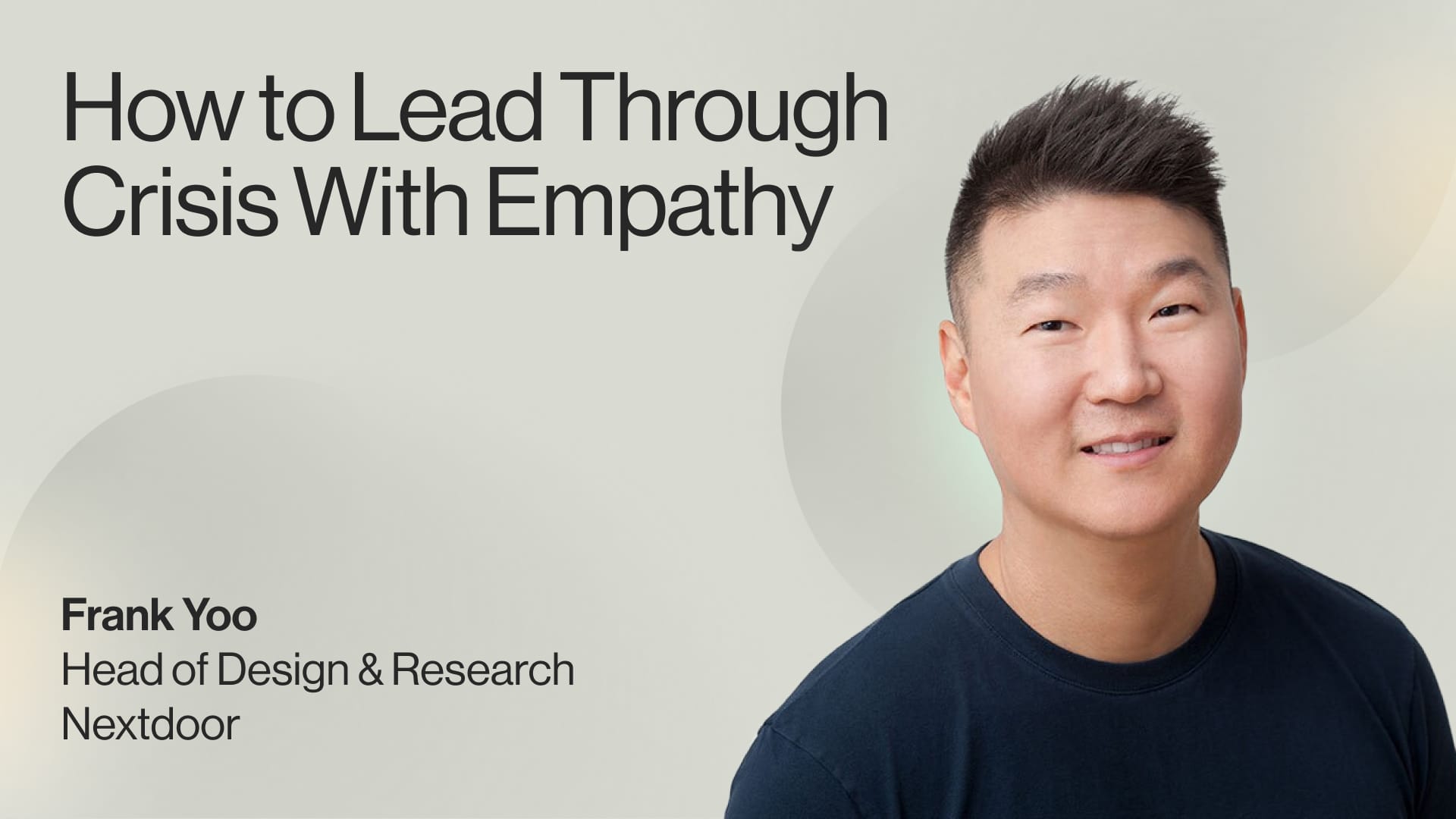
In this episode, we're joined by Frank Yoo, Head of Design & Research @ Nextdoor and previously at Coinbase, Google, and Lyft. We discuss the challenges of navigating cultural shifts and organizational changes, and how design leaders can maintain team stability and align with company values during times of uncertainty and lead with empathy.
Guest: Frank Yoo, Head of Design & Research @ Nextdoor
Host: Adam Perlis, CEO at Academy
🔴 Listen on YouTube:
🎧 Listen on Spotify:
Frank Yoo is Head of Design and Research at Nextdoor. Previously he led design and research across Coinbase's product portfolio and through the company's IPO rebrand, ran UX for Google's Gmail/Chat/Meet/Calendar communications suite, and spent seven years at Lyft. He is known inside the design leadership community for his thoughtful approach to leading teams through reorgs, layoffs, and market downturns.
Key Takeaways
- Frank's personal mantra during crisis is 'do the next right thing' — borrowed from a song. You can't control everything that happens to you or your team, but you can compartmentalize and take one correct step at a time.
- The worst thing you can do in a period of high anxiety is wing it. Frank is a strong advocate for writing down your full 'comms cascade' — who hears what, in what order, via which channel, in person or over Slack — so that nothing lands by accident.
- Putting a meeting on someone's calendar without context during a crisis can throw them into panic. Even the title of the meeting matters; an unexplained one-on-one invite after hours reads as 'am I getting fired?' when high-anxiety energy is in the room.
- Over-communicate when stakes are high. ICs and new managers don't have the context executives have, and they fill the vacuum with worst-case assumptions. If you can't share everything, share what you can and name what you can't.
- The diligent, over-engineered comms prep feels like overkill until you've seen what happens without it: more pain, more chaos, deeper damage to team morale and performance, and a much longer recovery.
- At Coinbase, Frank led design and research through the 2021 crypto bull run and the bear market that followed — including the rebrand for the IPO. The whiplash of those cycles is what taught him most about steadying a team through uncertainty.
- Crisis leadership is lonely. The selflessness and empathy that the job demands are rarely taught, and most design leaders learn them by trial and error. Having a trusted set of people business partners, legal counsel, and peers 'under the tent' is critical.
- Design leaders carry a unique burden during reorgs and layoffs — they have to hold team morale together while often knowing things they can't yet share. Preparing for those moments emotionally matters as much as preparing the comms plan.
Frequently Asked Questions
› Who is Frank Yoo?
Frank Yoo is Head of Design and Research at Nextdoor. Before Nextdoor he led design and research at Coinbase — including the company's IPO rebrand — through both the 2021 bull run and the bear market that followed. Before Coinbase he ran UX for Google's communications suite (Gmail, Chat, Meet, Calendar), and before Google he spent seven years at Lyft.
› How should design leaders communicate with their teams during a layoff or reorg?
Frank's answer is: over-communicate, and write everything down. Build a 'comms cascade' — a written plan of who learns what, in what order, via which channel, at what time. Consider every detail: is it in person or Slack? A phone call or a meeting? Sometimes the title of a calendar invite alone can throw a high-anxiety teammate into further crisis. The diligence feels over-engineered until you've seen the alternative.
› What's Frank Yoo's personal mantra for leading through crisis?
'Do the next right thing.' Frank borrowed the phrase from a song and says it's helped him keep agency in moments where so much is outside his control. You can't solve the whole thing at once — you can compartmentalize, take the next correct step, and repeat. That's the mantra he uses when things are happening to him and his team faster than he can fully process them.
› Why is over-communication so important during uncertainty?
Because anxious teammates fill information vacuums with worst-case scenarios. ICs and new managers don't have the context executives have, and in the absence of context a one-on-one on someone's calendar becomes 'am I getting fired?' — even when it isn't. Frank's rule is to give full context whenever you can, and to explicitly name the things you can't share, rather than letting silence do the talking.
› How does Frank Yoo plan crisis communications?
With a written comms cascade developed with his people-business partner, legal counsel, and management team. He documents the exact sequencing — who's told what, in what order, in what format — so that nothing is improvised. Frank has seen both well-planned and improvised layoff comms, and the recovery curve between them is dramatically different.
› What's the hardest part of leading design during a crisis?
The loneliness and the selflessness. You're holding team morale together while carrying information you can't yet share; the empathy the role demands isn't taught in design school or design management classes. Frank says he learned it mostly through trial and error, and by leaning on a trusted circle of advisors.
› What should you NOT do when leading a team through a layoff?
Wing it. Shoot from the hip. Schedule ad-hoc, unexplained one-on-ones. Assume people have context they don't. Each of those small missteps amplifies anxiety and extends the team's recovery time. Frank has seen all of them in practice and says the extra prep work always pays for itself.
› How did Frank Yoo's time at Coinbase shape how he leads at Nextdoor?
Frank went through the 2021 crypto bull run and the brutal bear market that followed, and led design through Coinbase's IPO rebrand in between. That whiplash — hyper-growth one quarter, downsizing the next — taught him most of what he now practices about steadying a design team through uncertainty.
Full Transcript
› Read the full conversation transcript
there's a song that's called do the do the next right thing or it might be the next right thing and something about it just resonated with me and it's been like a mantra and a just a reminder to myself as these things are happening to us that you can't you can't possibly you know control all the things you know and a lot of these things are beyond your control too they're not your fault they're not the team's fault they just they just start to happen to you and so you could either just let it wash over you and like tumble through it or you can have a little bit of agency and just compartmentalize things and just try to do the next right thing just take that first NE step hello everybody and welcome to how we scaled it for design teams a show that explores the journey through the arduous Road of growing a successful design practice I'm your host Adam Peis founder and CEO of Academy the ux Staffing and recruiting agency and today we have the pleasure of speaking with Frank youu head of design and research at nextto previously Frank worked coinbase Google and LT and in this episode we discuss the challenges of navigating the cultural shifts and organizational Chang and how design leaders can maintain team stability and align with company values during times of uncertainty but before we do that if you enjoyed this content please take two seconds to like And subscribe to our YouTube and Spotify channels it really mean a lot without further Ado welcome Frank awesome hey thanks for having me Adam so excited for our conversation big fan of the Pod so looking forward to getting into it awesome thank you so much Frank we really appreciate you being here so to give the audience a bit of context can you share a little bit about your journey from your early career to your current role as the head of design and research at next door sure yeah so just prior to this at my role at next door of head of design research I was at coinbase where I oversaw you know the design and research function for all sides of the product portfolio also rebranding the company as we were preparing to go public which was a super interesting experience as well and so I was there through the 2021 Bull Run then you know the bare Market that followed which will contribute a lot to this conversation we're having today then Google before that where I oversaw the ux teams for Gmail chat meet calendar and like generally the whole Suite of communications products and then prior to that a seven-year stint at Lyft where I was fortunate enough to be a member of the original cast of characters that created the product the service the brand all sides of the business from day one all the way up to the just before the IPO which is when I headed off to Google so that's kind of like my recent history in a nutshell wow I mean you've had such a tremendous career and have such a incredible resume I think one that a lot of people would dream of that's for sure I'd love to talk about something you and I you know spoke about briefly a few weeks ago which is really about navigating change and cultural moments you know we've talked about how these big cultural moments sometimes happen in companies and they can have a profound impact on a team can you give some examples of some of those moments to look out for design leaders yeah gosh you know there have been so many actually but particularly in the recent Arc of my of my career interestingly enough so thinking the situation that much of tech is in you know today it's been certainly a lot different today than it has been you know 3 four years back and prior to that where we work experiencing really like a Renaissance and a Heyday you know for everything that was that was Tech and more recently though you know the market conditions the aftermath of covid remote work then coming back to work you know and in these cultural moments politics cost reductions layoffs right many and many of us are kind of like having to figure this out this new landscape is so different than things were and it's kind of all happening at once you know and so it's been a big challenge something that's been very you know top of mind for me in each of my last you know three roles you know and what I'm finding is that there's no there's no Playbook right and so like what do you do you know it's it's very it's very lonely at times it's very disorienting for sure especially when you're kind of in the midst of what feels like Crisis you know time and time again and so it's like when they when these moments happen it's how do you manage to deal with them you know how do you what are some tangible things that we could do to help figure things out you know so those are the things that I that I been thinking about a lot in each of these roles more recently yeah and I think it's so refreshing to hear you say that you know sometimes you just you don't really know what to do there's no playbook for this you know that I think that's kind of the theme that a lot of design leaders feel but it's like saying the quiet part out loud to some degree because you know no one wants to admit that sometimes they aren't sure what to do and sometimes it's just trial and error sometimes it's learning from your experiences and I'm curious to hear you know about some of those experiences maybe that you have now experienced like how how have you handled some of these big changes that have happened and what have you learned along the way yeah I think some of it is just it's going through it you know and strug the struggle you know struggling through it and finding a way to just manage it and I you know sometimes you'll look for inspiration in odd places and you know my reference point recently has been what's most prevalent in my own life which has been you know family you know raising children learning how to do that very challenging work of being a better parent and making the family work you know and so I have two girls and huge Frozen fans and so one there's a song that's called do the do the next right thing or it might be the next right thing and something about it just reson ated with me and it's been like a mantra and a just a reminder to myself as these things are happening to us that you can't you can't possibly you know control all the things you know and a lot of these things are beyond your control too they're not your fault they're not the team's fault they just they just start to happen to you and so you could either just let it wash over you and like tumble through it or you can have a little bit of agency and just compartmentalize things and just try to do the next right thing just take that first Next Step make a little pocket of air around your around yourself just so you have just enough space to take inventory of what's Happening and then you have a little bit of you know you know ability to then come up with a strategy you know so it's just like you can't solve it all you it's overwhelming to have to think about it all at once and so as a reminder just to like just do the next thing you know just take that first step and regroup and then do it again and again and again yeah I think that it's definitely a good message for kind of overcoming that adversity and you know to get a little bit more specific and tactical you know like are there maybe some specific examples that you can share where you know perhaps there's been a big change in the company culture because there were some leadership changes at the toop or you know maybe unfortunately there may have been some layoffs in a company or maybe the product had to change directions like there was a pro product pivot you certainly don't need to drop Nam or name companies or anything but in speaking more in generalities because you've been through a lot of these things maybe we can speak to some of those examples and talk about like how like how you've handled them and you know some of the things that you learned or had difficulty with along the way yeah you know at well at coinbase I mean it's it's it's no secret that crypto's gone through went through a tough period just recently you know was when I joined in 2020 and through 2021 it was just riding high it was like a really crazy Bull Run was happening our team was growing like crazy there was a lot of you know top of mine share in the crypto space for a while during that time and things were riding High then just as fast as you know things were on the upswing the bottom fell out you know and 2022 which was hard you know because it was so abrupt and this is where the things started happening so there was the the macro conditions and like the bare market and as a company you have to respond to that you know you can't hire at the pace that you were because all of a sudden there's less interest in your there's less activity on the platform and so there's there's a lot of changes that are happening that are predicated by those macro external factors so change in strategy a pause first of hiring and then a you know then Cuts you know to and reductions and force and that have to follow in order to bring costs back in line with you know with revenue and so it's very dis it's very disruptive you know and again like kind of when all that's happening to you all at once it's easy to just want to like hide into a corner and curl up and just you know wish things to go away but I think that's where I start to employ some of these tactics to just take a breath what immediately needs to be resolved today right now so in this example one of the first things that I would do is like I pull in my people business partner it's it's such an important relationship that I have grown to rely on probably I would say my most important partnership when you're when you're trying to build a a high functioning you know a culturally strong team resilient team and to put together to understand what happened you know what can we who else is in Under the Tent so to speak who else can we talk to about this right what needs to happen from here how do we communicate this to the rest of the of the group and so I think that those are the first things that I look to do when there's one of these moments that's either upon us or about to be about to drop where you could start to be strategic where you could start to then reference some of the protocols that exist you know that are that are meant to be these back stops to help you run your team from a an operational perspective as you're figuring out all the other factors you know like the people thing the product things the Str the product strategy and things like that so that's kind of that's where my mind goes is to seek out those key Partnerships think about the very next step that needs to happen put that strategy together and then figure out how to deploy that strategy with you know for your team and then the communication piece of it is also like incredibly important yeah I mean it's it's almost like Crisis management you know and that is definitely not something they teach you in design school or any school frankly for that matter I mean this is like the leadership you know crash course but no one no one's teaching it you're just a train wreck no I mean I think that's those are wonderful tips I mean just kind of play that back to you it sounds like you know that part partnership you know when that moment happens where you're getting some bad news and you're going to need to communicate it to the team somehow you know it's really important to come up with a plan and that plan shouldn't be done in a vacuum like you need to involve some other partners including your you know HR or people team maybe even your operations team because they could have a big impact you know also maybe even your legal team cuz you know the things that you share you know may impact the stock price or right there are things you know the message getting leaked out outside of your team can have you know Ripple effects also maybe your team's not affected but other teams are or you know so that can have a big impact on the company culture and so I think that's very it's very interesting to hear about like that cuz I don't think that everybody has been through that and sometimes they you know they need to learn how to manage it in that moment one of the one of the other things you and I talked about I remember is like kind of a different topic but something related is you know when you need to have a tough conversation with somebody or maybe not you just need to have a conversation with somebody and putting you know a a meeting on their calendar without like saying explicitly what it's for can you tell me a little bit about like what you learned from that type of experience it seems tactical and but it's it's a very nuanced thing that could have as you're saying like a very big impact on how it's received so it's during these times of Crisis where there's a lot of anxiety you know that's and the energy in the room is just very it's fearful you know it's fearful people don't know what that they don't have all the information particularly when you're talking about your ic's and your new managers too and everyone's just wondering what's what's happening what's going on when are we going to learn more why aren't they saying more you know and so in those times if you go and you put a meeting it could be a one-on-one it could be a team meeting and you don't provide the context or you accidentally provide the wrong context even in the title of the meeting itself it could throw someone into further crisis you know because that anxiety is so high and the sensitivities are so are so high that if you just throw one-on-one on someone's calendar you know ad hoc that's not a standing scheduled meeting they're going to be like oh my gosh am I getting fir or like what is what did I do you know what is happening to me and if you don't so you have to overc communicate in those circumstances and put people at ease make sure they have the full context that you're able to share with them and sometimes you can like you mentioned there that's what makes this so difficult like sometimes there are things that you can and things that you cannot say because there are all these other second order risks that are associated with doing that so but I think that's where it's it helps to have those conversations with your people business partner with your with your legal representative with your management team those that are Under the Tent to then these are the conversations that we have you know the we call it like the comms Cascade strategy you know and we and you it's important that you write it down and so you don't miss you don't miss these details that's something that's all like down to like the meeting if are you going to do it over Slack are you going to do it over are you going to be in person you know are you going to is it going to be a phone call or whatever when are you going to do it in what sequence are you doing it in what order are people finding out you know so it's it gets pretty complicated but it's important that you do that diligence work so that by the time it lands with the person it you've done your best to manage that anxiety and you're able to be as transparent as possible when the time comes so on the other on the flip side if you kind of wing it and you're shooting from the hip through because I've seen that too it just leads to more pain and more chaos and more confusion and further hand ringing which is it just makes the recovery process that much more difficult so I that's something that I learned is like it seems very Tactical kind of over engineered at times to go through a process so rigorously but when you think about the potential impact of not doing that or you see it worse yet then it helps you know justify putting in that extra effort yeah I mean it can deeply affect team morale you know work performance lack of Cl ity and Direction all of it that just like without if you don't go in with a plan you're you're going to be in a bad position and I think also you know some of the things you've talked about are kind of like how lonely it is at that in your position at that moment because it's such a challenge and also kind of like the selflessness that's required and the empathy that's required which are just like things that are also not really taught and I'm curious to hear and you know how did you like learn these things how did you how did how have you been able to approach these moments with such Clarity even though at times maybe it wasn't so clear well I'll say in the beginning it was a little little trial and error you know you learn from your stumbles and where you where you did it wrong or where you didn't have that conversation or you didn't put yourself in the other person's circumstances and think it through that way so I think some of it has been learning through mistakes certainly and I credit the people that had the were brave enough to tell me so you know and give me that feedback cuz otherwise I just would have thought everything was cool you know the way I the way I did it incorrectly and so there are a couple circumstances that I remember earlier on in my leadership Journey where I mean and definitely more so earlier on where there were more of those conversations and those feedback Loops I will also say too that being on the other end of it you know we've all had have had amazing managers and have had you know other managers that we think could have been that maybe weren't the best fit for us but like where we experience these things too on the other end of it and so you people remember those things you know that those interactions that they have with their leaders and their their managers you know and I keep I try to REM you know keep that in mind as well because It's a Small World most of us aren't going to stay at the same place for forever and so that it's likely that we will work with these people again and so you want to remember that you know it's it's about relationships are so important and putting yourself in the other person's circumstances and really understanding that has been the probably one of the best teachers for me in developing my own style when in terms of helping me decide how I'm going to show up or the things that I'm going to do to prepare for these tough conversations and so again it w always get it right still and but I try to remember that from these experiences like the all the scar tissue that we built up and like this kind of pseud of armor and this resilience that we build up over time that it takes the experiences and the battles to go through for you to have this you know for you to have the scars to prove it you know to go through it again to withstand the next moment and so I find with each successive moment at each new role each new piece of feedback you kind of you de you had you develop your own kind of jalopy Playbook you know over time that you can kind of reference the next time things happen yeah no that's that's beautiful and thank you for being so you know vulnerable and expressing such humility with it I mean yeah I think we've all been there and had those you know maybe managers who haven't been so great and we've maybe you know lot a lot of times it's easy to assign blame and say oh they were a terrible manager but it's also a great opportunity to have learned to be like oh yeah that's I'm going to do the opposite of that I'm going to be I'm going to be the opposite of that because I remember how I felt in that moment or I remember how they handled that and I would have done it differently so I think it's both you know the experiences that you've had like as a leader that's like one part of the learning but also the experiences you've had as being in the seat of maybe your team you know where they are today and having maybe even been through some of those crisises back then and really being mindful of those times and thinking about them and remembering them so that when you become a leader and you have to deal with them you'll have a Playbook if you will to to address them one other one other thing that you had said to me which I'd love to quote you on and you mentioned to shock absorb and not Shock amplify can you tell the audience what you mean by that yes I love this one it's this is something that I picked up from my time at coinbase and it's it was a refrain that you would that would you would hear often there I don't know who coined it I can't quite remember something that I quickly it resonated with me and something I quickly adopted and have continued to use with my teams particularly my leadership teams and what it means is when you're going through one of these difficult moments part of you wants to through to empathize wants to kind of put yourself in the same to commiserate right with folks and that might feel good in the moment it might even be received well by the person that's going through it but at the same time you and your leadership position aren't doing what's necessary to help settle things down and stabilize the team so it's a it's a very different responsibility I think for leadership to take some of the brunt of that that moment what whatever had happened and kind of because we're better equipped to withstand the shock and then translate that and transform that into something that lands better with the team you know whether it's adding context adding some personal experience putting it through the filter of your stylistic delivery you know all that stuff then helps the team settle the team versus just kind of like bouncing it back off to the you know directly as you heard it back to the team cuz like what that could all what that could lead to is it just reverberates and it just creates more tension and more fear and more anxiety and the worst case like anger you know and resentment and so it could really like Spiral into something that's really bad and unhealthy and when you think about what you're there to do you know at the end of the day like it's it's work and we want to feel productive Ive you know we want to be able to do you know ship that amazing feature and like you know dig into this design Challenge and you know spend time with our with our users but like when all this is happening and you're not able to settle back into some semblance of a stable environment you can't do that you know it takes you further away from doing what you're there to do and so I think the underlying goal here is not to brush stuff under the rug but to help the team actively help the team find equilibrium again and so that's what like the helping absorb the shock as the leadership layer really helps achieve because when you're able to then slowly return back to equilibrium where you're focused again on the work and you're you're contributing again with fewer distractions and you're shipping and you're driving impact for the business and the business does well that tends to be the rising tide that makes all boats rise you know it's like when things are going well morale tends to be higher you know people are recognized for their hard work you know they some of the pressure start to lift and you know people are smiling again so I think it's all trying to drive stability towards that particular outcome you know so that's I think that is kind of a guiding a guiding principle for me wow I could not have said it better myself I think that's brilliant I mean I don't think people appreciate how challenging it is to do that Balancing Act of you know both having to take in hard news having to balance your own emotions with what another person might be going through not falling into those trappings of you know wanting to deeply empathize with this person and and commiserate and also maintaining your professionalism and kind of like a composure and and also the fact that you do also have a job to do which is to help this company move forward and past this moment and so you have Executives and other people you kind of have to answer to as well so it's a very delicate balance that you're tight rope you're walking if you will so I don't think anybody's got as you said the proper playbook for this and even you with lots of experience I'm sure have your struggles but I think the audience will really appreciate some of the advice that you've given them today because there's definitely some really golden nuggets of wisdom to walk away from this rank I wanted to thank you so much for joining us today this has been a really amazing chat if the audience wants to follow along with any of your thinking speaking engagements or or generally speaking your career what's the best way for them to to learn more about you I would say Twitter umf franku I don't tweet a lot I don't I'm not writing a lot but when I when there is an opportunity for me to do so that's probably where I' I'd announce it and then on LinkedIn as well so I would say those would be the two the two channels amazing awesome well Frank we're going to be following your career closely we really appreciate you taking the time with us and yeah if if we can we'd love to have you back sometime so thank you again for for being here and have a wonderful weekend I really appreciate Adam I thoroughly enjoyed the conversation and I'll see you soon awesome thanks Frank great weekend